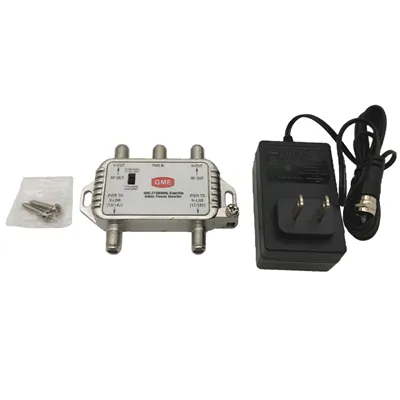
Hey there! As a supplier of IPQAM modulators, I'm super excited to dive into the hardware components that make these devices tick. IPQAM, or Internet Protocol Quadrature Amplitude Modulator, is a key piece of tech in the world of cable TV and broadband networks. It takes IP - based digital video and audio streams and converts them into a format that can be transmitted over traditional cable TV networks. Let's break down the main hardware components of an IPQAM modulator.
1. Network Interface Cards (NICs)
First up, we've got Network Interface Cards. These are like the gateways for data to enter the IPQAM modulator. NICs are responsible for receiving the IP - based media streams from the network. They support different network protocols such as Ethernet, which is super common in local area networks (LANs) and wide area networks (WANs).
Most modern IPQAM modulators come with high - speed NICs that can handle gigabit or even 10 - gigabit Ethernet connections. This high - speed data transfer is crucial because it allows the modulator to receive large amounts of video and audio data in real - time without any lag. For example, if you're delivering multiple high - definition video channels simultaneously, a fast NIC ensures that all the data gets in quickly and smoothly.
2. Signal Processing Unit
The signal processing unit is the brain of the IPQAM modulator. It's where all the magic happens. This unit takes the raw IP data received through the NICs and processes it. It decodes the IP packets, extracts the video and audio streams, and then prepares them for modulation.
Inside the signal processing unit, there are usually multiple microprocessors and application - specific integrated circuits (ASICs). These chips are designed to handle complex algorithms for error correction, packet reassembly, and format conversion. For instance, they can convert the MPEG - 2 or MPEG - 4 video streams that are commonly used in IP - based media into a format that's suitable for QAM modulation.
3. Modulation Unit
Once the signal has been processed, it's time for the modulation unit to step in. The modulation unit is responsible for converting the digital video and audio signals into analog signals that can be transmitted over the cable TV network. It uses Quadrature Amplitude Modulation (QAM), which is a technique that combines amplitude and phase modulation to transmit multiple bits of data per symbol.
There are different levels of QAM, such as 64 - QAM and 256 - QAM. Higher - order QAM schemes can transmit more data per symbol, which means higher data rates. However, they also require a higher signal - to - noise ratio to maintain a reliable connection. The modulation unit in an IPQAM modulator can be configured to use different QAM levels depending on the requirements of the network and the quality of the cable infrastructure.
4. RF Output Section
The RF (Radio Frequency) output section takes the modulated analog signals and prepares them for transmission over the cable. It amplifies the signals to the appropriate power level and filters out any unwanted frequencies. This ensures that the signals can travel long distances over the cable network without significant loss or interference.
The RF output section typically includes power amplifiers, filters, and impedance matching circuits. The power amplifiers boost the signal strength, while the filters remove any noise or interference that could degrade the quality of the transmitted signal. Impedance matching circuits ensure that the signal is transferred efficiently between different components in the modulator and the cable network.
5. Power Supply
You can't have a working IPQAM modulator without a reliable power supply. The power supply unit provides the necessary electrical power to all the other components in the modulator. It converts the incoming AC power from the wall outlet into the DC power that the microprocessors, chips, and other electronic components need.
A good power supply unit is designed to be efficient and stable. It should be able to handle fluctuations in the input voltage and provide a constant output voltage to ensure the proper operation of the modulator. Some IPQAM modulators also come with redundant power supplies for added reliability. In case one power supply fails, the other one can keep the modulator running.
6. Cooling System
All these components generate a lot of heat during operation. That's where the cooling system comes in. The cooling system is essential for preventing the modulator from overheating, which could cause damage to the components and lead to system failures.
Most IPQAM modulators use a combination of fans and heat sinks to dissipate the heat. The fans blow air over the heat sinks, which are made of materials with high thermal conductivity, such as aluminum. The heat sinks absorb the heat from the components and transfer it to the air, which is then expelled from the modulator.
7. Front - Panel and Control Interface
The front - panel and control interface allow users to interact with the IPQAM modulator. The front - panel usually has indicators that show the status of the modulator, such as power on/off, network connectivity, and signal strength. It may also have buttons or switches for basic configuration and control.
The control interface, on the other hand, provides more advanced configuration options. It can be a web - based interface that allows users to access the modulator's settings and parameters through a browser. This makes it easy for network administrators to manage multiple IPQAM modulators remotely.


Additional Related Products
If you're interested in other products that work in conjunction with IPQAM modulators, we've got some great options. Check out our 1 Channel HDMI To IP Streamer with RCA Input. It's a handy device that can convert HDMI and RCA audio - video signals into IP streams, which can then be fed into the IPQAM modulator.
Another great product is the XPON ONU 4GE CATV WiFi6 ONU. This ONU is designed to provide high - speed broadband and CATV services over a single fiber connection. It can be used in conjunction with an IPQAM modulator to deliver a complete solution for cable TV and broadband networks.
And don't forget about our SFP Module LC SC Optical. These modules are used for optical fiber connections in network equipment, including IPQAM modulators. They provide a reliable and high - speed way to connect the modulator to other devices in the network.
Let's Talk Business
If you're in the market for IPQAM modulators or any of the related products I've mentioned, I'd love to have a chat with you. Whether you're a cable TV provider looking to upgrade your network, a broadband service provider expanding your offerings, or a system integrator working on a new project, we've got the solutions you need. Just reach out, and we can start discussing how our products can meet your specific requirements.
References
- "Cable Television Technology Handbook"
- "Digital Video Broadcasting - Cable (DVB - C) Standards"
- "Networking and Telecommunications Fundamentals"