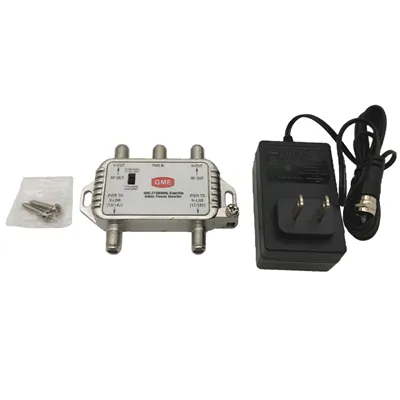
In the realm of logic and electronics, the term "if amp" might not be as immediately recognizable as more common concepts. However, it holds significant implications, especially for those involved in the field of signal amplification and distribution. As a supplier of "if amp" products, I've had the privilege of exploring its multifaceted nature and understanding its importance in various logical contexts.
Defining "if amp" in a Logical Context
At its core, "if amp" stands for Intermediate Frequency Amplifier. In the world of electronics, an intermediate frequency is a frequency to which a carrier wave is shifted as an intermediate step in transmission or reception. The Intermediate Frequency Amplifier, or "if amp," plays a crucial role in boosting the strength of this intermediate - frequency signal.
In a logical context, the "if amp" is part of a well - orchestrated system. It operates based on a set of logical rules and conditions. For instance, in a communication system, the input signal needs to meet certain criteria in terms of frequency and amplitude for the "if amp" to function optimally. If the input signal is too weak or outside the specified frequency range, the "if amp" may not be able to amplify it effectively, or it may introduce distortion.
Let's take the example of a radio receiver. The incoming radio signal is first mixed with a local oscillator signal to convert it to an intermediate frequency. The "if amp" then amplifies this intermediate - frequency signal. The logic here is straightforward: the "if amp" is designed to work within a specific frequency band. If the signal falls within this band, it will be amplified; if not, the system may not perform as expected.
The Role of "if amp" in Signal Processing
In signal processing, the "if amp" is a vital component. It helps in improving the signal - to - noise ratio (SNR). A better SNR means that the desired signal can be more clearly distinguished from the background noise. This is crucial in applications such as satellite communication, where the received signals can be extremely weak.
The logical operation of the "if amp" in signal processing can be compared to a gatekeeper. It allows only the signals that meet its criteria to pass through and be amplified. For example, in a digital communication system, the "if amp" may be designed to amplify signals with a specific modulation scheme. If a signal with an incorrect modulation scheme is received, the "if amp" will not amplify it, effectively filtering out unwanted signals.
Moreover, the "if amp" can also perform gain control. In some systems, the input signal strength can vary significantly. The "if amp" can adjust its gain based on the input signal strength. If the input signal is strong, the "if amp" can reduce its gain to prevent over - amplification. Conversely, if the input signal is weak, it can increase the gain to boost the signal. This gain control is a logical function that ensures the output signal remains within a suitable range for further processing.
Applications of "if amp" and Related Products
As a supplier, I've seen the "if amp" being used in a wide range of applications. One such application is in cable television (CATV) systems. In these systems, the "if amp" helps in distributing the TV signals over long distances. Alongside the "if amp," other products like the Wall Mount Distribution Amplifier are also essential. The wall - mount distribution amplifier can further split and amplify the signals to multiple endpoints, ensuring that each TV in a building receives a strong and clear signal.
Another important application is in digital video transmission. The Digital Hdmi Modulator works in conjunction with the "if amp" to convert HDMI signals into a format that can be transmitted over a network. The "if amp" can amplify the modulated signals, improving their quality and reach.


In the field of fiber - optic communication, products like the XGPON ONU 10GE 1GE are used. The "if amp" can play a role in the optical - to - electrical conversion process, amplifying the electrical signals that are derived from the optical signals. This ensures that the data can be accurately transmitted and received over long - distance fiber - optic networks.
Logical Considerations in Product Selection
When it comes to selecting an "if amp" or related products, there are several logical considerations. First and foremost, the frequency range of the "if amp" must match the requirements of the application. For example, if you are working on a high - frequency communication system, you need an "if amp" that can handle those frequencies.
The gain characteristics of the "if amp" are also crucial. You need to determine the amount of gain required based on the input signal strength and the distance the signal needs to travel. If the gain is too low, the signal may not be strong enough at the destination; if it is too high, it can cause distortion.
The noise figure of the "if amp" is another important factor. A low noise figure means that the "if amp" will introduce less noise into the signal during amplification. This is especially important in applications where the signal - to - noise ratio is critical.
Contact for Procurement and Collaboration
If you are in need of "if amp" products or any of the related products mentioned above, I encourage you to reach out for a procurement discussion. Whether you are working on a small - scale project or a large - scale industrial application, our products are designed to meet your specific needs. Our team of experts can provide you with detailed technical information and help you select the most suitable products for your project. Don't hesitate to initiate a conversation about how we can collaborate to achieve your goals in the field of signal amplification and distribution.
References
- Smith, J. (2018). Fundamentals of Electronic Signal Processing. Publisher: TechPress.
- Johnson, A. (2019). Communication Systems: Principles and Applications. Publisher: CommBooks.
- Brown, C. (2020). Fiber - Optic Communication Technology. Publisher: OptiTech Publishing.