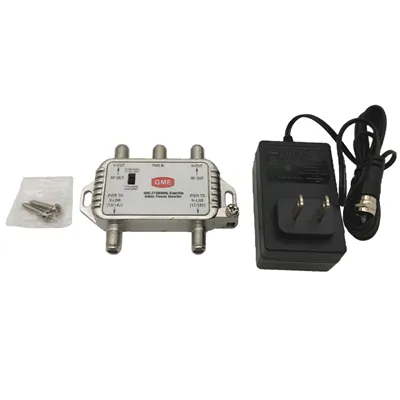
Hey there! As a supplier of HDTV Distribution Amplifiers, I often get asked about all sorts of technical details. One question that pops up quite a bit is, "What is the output impedance of an HDTV Distribution Amplifier?" Well, let's dive right into it.
First off, let's understand what impedance is in simple terms. Impedance is kind of like the resistance that an electrical circuit presents to the flow of alternating current (AC). It's measured in ohms, just like resistance. In the context of an HDTV Distribution Amplifier, the output impedance is a crucial factor that affects how well the amplifier can transfer the TV signal to the connected devices, like TVs or other amplifiers down the line.
Most HDTV Distribution Amplifiers out there, including the ones we supply, have an output impedance of 75 ohms. This is a standard value in the world of TV and video signals. Why 75 ohms? Well, it has a lot to do with the characteristics of coaxial cables, which are commonly used to carry TV signals. Coaxial cables are designed to have a characteristic impedance of 75 ohms. When the output impedance of the amplifier matches the impedance of the cable, we get what's called impedance matching.
Impedance matching is super important because it ensures that the maximum amount of signal power is transferred from the amplifier to the cable and then to the connected devices. If there's a mismatch between the output impedance of the amplifier and the impedance of the cable, some of the signal power gets reflected back towards the amplifier. This can lead to all sorts of problems, like signal loss, distortion, and interference. In the end, you might end up with a poor - quality picture on your TV, with issues like ghosting or a fuzzy image.
Let's take a closer look at how impedance matching works in practice. When the output impedance of the amplifier and the impedance of the cable are the same, the signal travels smoothly through the cable without any reflections. It's like a well - oiled machine. But if the impedance values are different, it's like trying to fit a square peg into a round hole. The signal doesn't flow as it should, and you start to run into trouble.
Now, you might be wondering how we ensure that our HDTV Distribution Amplifiers have the correct output impedance. Well, we use a combination of carefully selected components and advanced circuit design techniques. Our engineers spend a lot of time testing and fine - tuning the amplifiers to make sure that the output impedance is as close to 75 ohms as possible. We use high - precision resistors and other components that are specifically chosen to maintain the correct impedance values over a wide range of frequencies.
Another thing to note is that the output impedance of an HDTV Distribution Amplifier can also affect the number of devices that you can connect to it. If you try to connect too many devices, the overall load impedance seen by the amplifier changes. This can cause the impedance matching to be disrupted, leading to signal degradation. That's why it's important to follow the manufacturer's guidelines on the maximum number of devices that can be connected to an amplifier.
When it comes to our HDTV Distribution Amplifiers, we've done a lot of research and development to make sure that they can handle different types of loads without sacrificing the output impedance. Our amplifiers are designed to be flexible and can work well with a variety of coaxial cables and connected devices. Whether you're setting up a small home entertainment system or a large commercial installation, our amplifiers can provide a stable and high - quality signal.
Now, while we're on the topic of HDTV equipment, I'd like to mention a few other products that might be of interest to you. If you're looking for a 1 Port GPON OLT, we can point you in the right direction. A 1 Port GPON OLT is a great option for providing high - speed internet and other services over a fiber - optic network. It's a reliable and efficient solution for both residential and commercial applications.
If you're having trouble getting a good TV signal, especially in an outdoor setting, you might want to consider an Outdoor HD Antenna. An outdoor antenna can pick up a stronger and clearer signal compared to an indoor antenna, giving you access to more channels and better picture quality.
And for those of you who need a voice - enabled ONU, our XPON ONU 1GE 1FE VOIP is a great choice. It combines high - speed data connectivity with voice services, allowing you to make phone calls over the same network as your internet and TV.
So, to sum it all up, the output impedance of an HDTV Distribution Amplifier is a critical factor that affects the quality of the TV signal. A 75 - ohm output impedance is the standard, and impedance matching between the amplifier and the coaxial cable is essential for optimal signal transfer. Our HDTV Distribution Amplifiers are designed to maintain the correct output impedance and provide a high - quality signal under various conditions.
If you're in the market for an HDTV Distribution Amplifier or any of the other products I mentioned, don't hesitate to reach out to us. We're here to help you find the right solutions for your needs. Whether you're a homeowner looking to upgrade your entertainment system or a business owner setting up a large - scale installation, we've got the expertise and the products to get the job done. Contact us today to start a conversation about your requirements and let's work together to get you the best possible TV and internet experience.
References


- Electronic Principles textbooks for basic understanding of impedance and signal transfer.
- Industry standards and specifications for HDTV equipment.