

As gigabit broadband penetration accelerates worldwide, achieving full indoor network coverage at the lowest cost and highest efficiency has become a real-world challenge for telecom operators, system integrators, and end users alike. Against this backdrop, Ethernet over Coax (EoC) technology based on the ITU‑T G.hn international standard is enjoying a "second spring." Recently, communications equipment manufacturer Good Mind Electronics (referred to as "Good Mind") introduced its 2550MA EoC Gigabit Adapter Kit, which delivers a coaxial transmission rate of up to 1.7 Gbps and a transmission distance of 1.4 km, offering a highly competitive solution for home networking, commercial buildings, and multi‑dwelling units (MDUs).
G.hn: Giving Existing Coax Cables a "Second Life"
G.hn is a home networking international standard (G.9960/G.9961) established by the International Telecommunication Union (ITU‑T), designed to enable high‑speed data transmission over existing coaxial cables, telephone lines, and power lines. The technology's greatest strength lies in its ability to "reuse legacy infrastructure"-it converts a building's existing TV coaxial cables into high‑speed Ethernet transmission channels without the need for new cabling. According to the HomeGrid Forum, G.hn is the only networking technology based on globally recognised ITU‑T standards that can deliver multi‑gigabit connectivity over multiple media, including coaxial cable, telephone copper wire, power lines, and plastic optical fibre.
In China's broadcasting industry, G.hn EoC technology is seen as an effective way to solve the "last‑100‑metre" coax access problem-it combines G.hn PHY‑layer technology with the EoC access network architecture, balancing the maturity of international standards with local network adaptability. With the maturation of G.hn Wave 2 technology, mainstream products can now achieve physical‑layer rates of up to 2 Gbps and effective throughput of 1.7 Gbps over coaxial media.
2550MA Adapter Kit: 1.7 Gbps Data Rate and 1.4 km Transmission
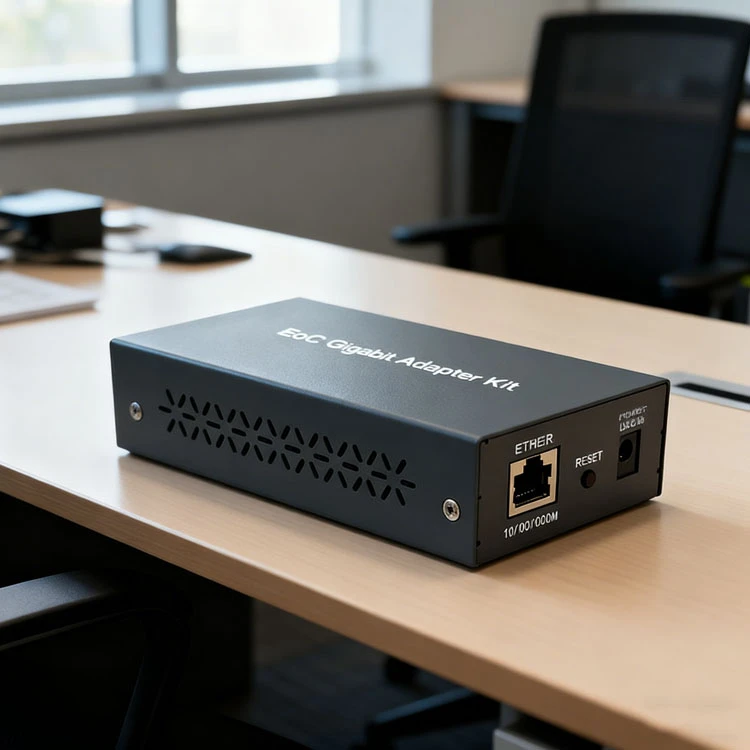
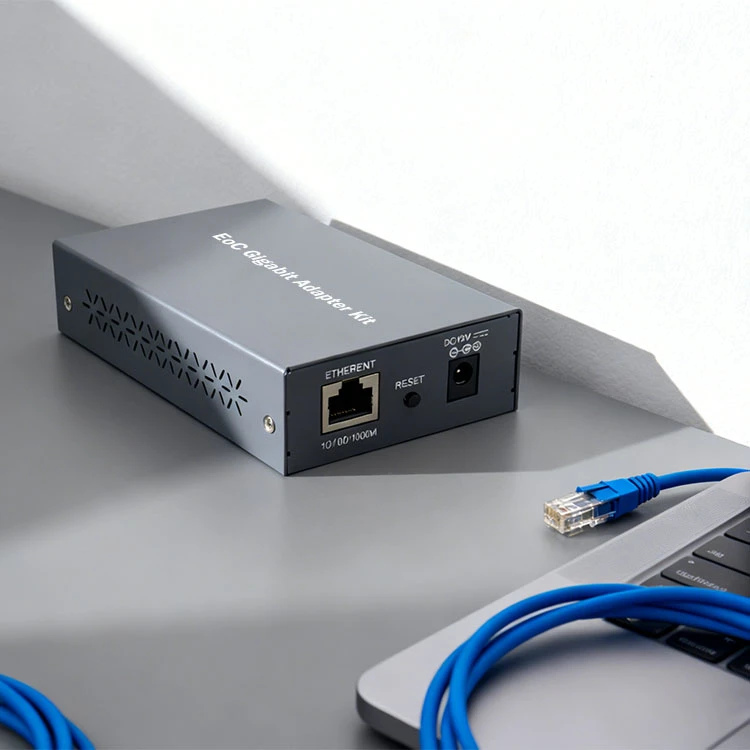
The newly launched 2550MA EoC Gigabit Adapter Kit represents the latest productisation of G.hn technology in access‑layer applications. Based on the ITU‑T G.9960/G.9961 standards, the product operates in the 2–200 MHz frequency band and supports IGMP Snooping. In terms of core performance, the 2550MA delivers a coaxial transmission rate of up to 1.7 Gbps, and its Ethernet port supports 10/100/1000BASE‑T auto‑negotiation. For transmission distance, the coaxial interface can withstand up to 70 dB of attenuation, while the maximum Ethernet cable distance is 100 metres.
In terms of interfaces, the adapter is equipped with one F‑type female coaxial connector and one RJ45 Gigabit Ethernet port, along with a reset button for system reboot or factory reset. The product features a wall‑mountable design with two‑way keyhole slots, facilitating secure installation in professional deployment scenarios. Power is supplied via DC 12V/1A, and the device dimensions are 61×118×28 mm (excluding mounting ears), with an operating temperature range of 0°C to 40°C.
In terms of application scenarios, the 2550MA adapter kit can be widely used for data backhaul from HD IP cameras, wireless access points, network video recorders (NVRs), and digital signage, covering home networks, commercial buildings, MDUs, and Internet Service Provider (ISP) deployments. The product supports simultaneous transmission of TV signals and Ethernet signals, and can coexist with CATV and SAT TV, enabling multiple services over a single coaxial cable.
EoC Adapter Market Continues to Expand, with G.hn Solutions Becoming a Key Growth Driver
From an industry perspective, the EoC adapter market is in a phase of rapid growth. According to a report by Lucintel, driven by rising demand for high‑speed data transmission, the proliferation of smart home technologies, and the need for cost‑effective networking solutions, the global EoC adapter market is expected to grow at a compound annual growth rate (CAGR) of 8.1% from 2025 to 2031. Separately, QYResearch estimates that global sales of coaxial‑to‑Ethernet converters reached USD 567 million in 2025 and are projected to grow to USD 835 million by 2032.
In terms of technology roadmaps, G.hn Wave‑2 over Coax has become one of the key segments in the EoC market, competing with other standards such as MoCA 2.0/2.5 and DOCSIS EoC Bridging. Market analysts note that ongoing innovations in modulation techniques, signal processing, and noise suppression are enabling EoC adapters to achieve higher data rates, better signal integrity, and longer transmission distances, preserving their competitive advantage over fibre‑optic and wireless alternatives.
"Legacy Upgrade" Demand Opens a Window of Opportunity for G.hn
For a large number of existing residential and commercial buildings, re‑laying Ethernet cabling is not only costly but may also involve wall damage and property‑rights disputes. The G.hn over Coax solution fills this market gap perfectly-users simply need to connect one G.hn adapter at the optical network terminal and another in each room to deliver the operator's gigabit fibre bandwidth without loss to every room, fully supporting bandwidth‑intensive applications such as 8K video streaming and VR gaming. In the security surveillance sector, some equipment manufacturers have begun integrating G.hn over Coax interfaces directly into network cameras, using the building's existing coaxial cable as the surveillance backbone while also supporting Power over Coax (PoC), greatly simplifying the digital upgrade of security systems in older buildings.
Good Mind has stated that it will continue to invest in the G.hn technology roadmap and promote the deployment of coaxial Ethernet products across a broader range of applications. As global broadband infrastructure evolves from "fibre‑to‑the‑building" to "fibre‑to‑the‑room," G.hn EoC adapter products like the 2550MA are poised to play an increasingly important role in the network upgrade wave for legacy buildings.


