

In the wave of digital transformation, high-speed, stable network connectivity has become a necessity for modern living and business operations. However, for owners and operators of Multi-Dwelling Units (MDUs), hotels, senior living communities, and even aging buildings, the "last mile" network retrofit remains a persistent challenge - fiber-to-the-home (FTTH) is ideal, but comes with high installation costs, long construction periods, and significant disruption to normal operations.
The combination of G.hn over Coax and Wi-Fi 6 is revolutionizing this dilemma. It merges two complementary technologies into a unified connectivity solution: leveraging existing coaxial cables within buildings as a gigabit-class wired backbone, and using Wi-Fi 6 for seamless indoor wireless coverage. This approach delivers a fiber-like networking experience without trenching cables or interrupting business operations - all while reusing legacy wiring.
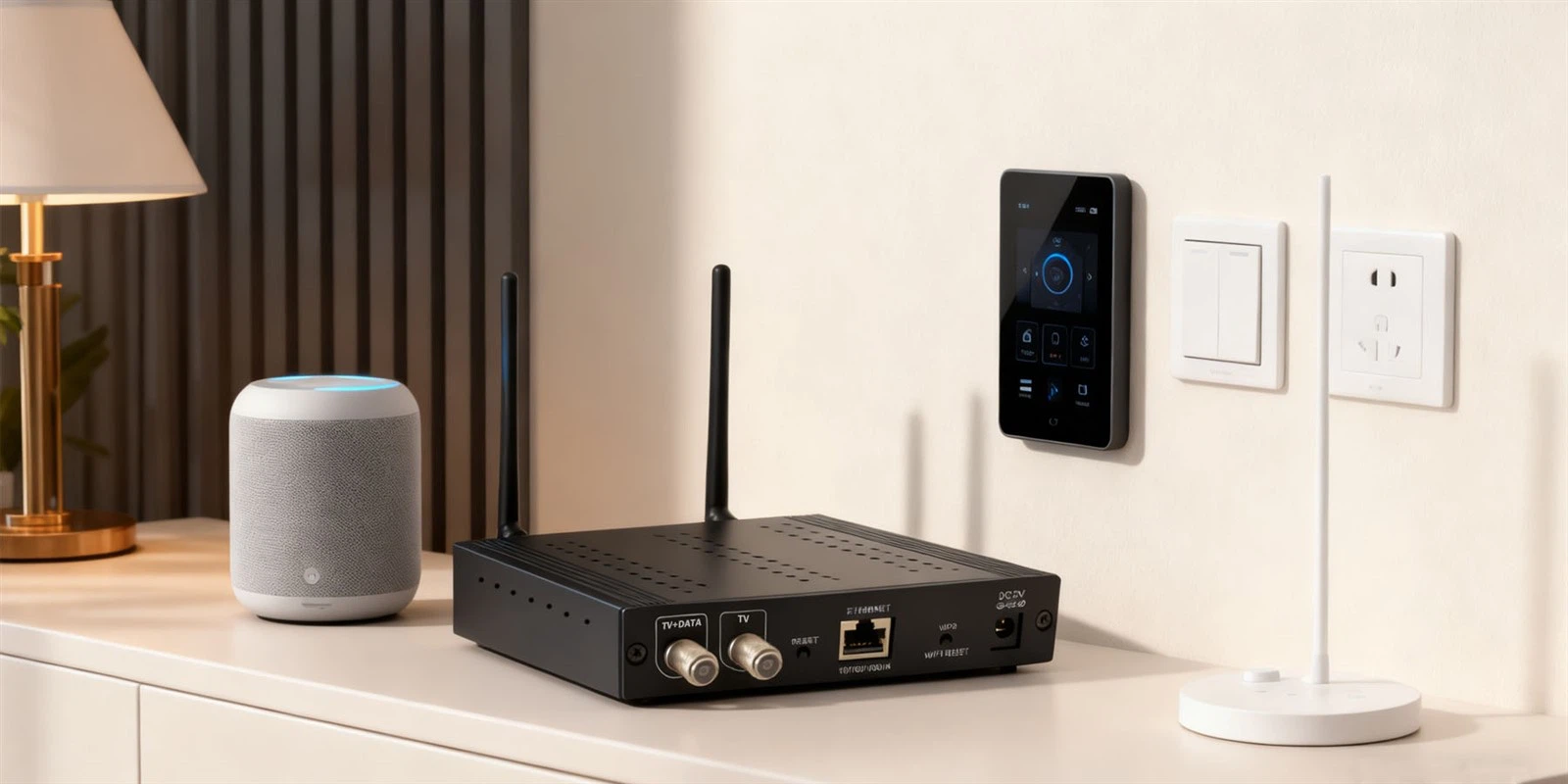
I. The Root of the Pain: Copper is Easy to Find, Fiber is Hard to Lay
Hundreds of millions of homes, hotel rooms, and commercial buildings worldwide already have extensive coaxial cable networks. These were originally installed for cable TV (CATV) and satellite television. With the rise of cord-cutting, large amounts of coaxial cable sit idle - a wasted infrastructure asset hidden within walls.
Meanwhile, the post-pandemic era of hybrid work, 4K/8K streaming, cloud gaming, and smart home applications places unprecedented demands on indoor network bandwidth. While Wi-Fi 6 significantly improves wireless access capabilities, its performance heavily depends on the backhaul connection between access points (APs) and endpoints. Once the backhaul becomes a bottleneck, even the most advanced wireless technology cannot deliver its promised performance.
Traditional solutions face a dilemma: full-home fiber retrofitting means tearing open walls and drilling holes, which is costly and disruptive to occupancy and operations; pure wireless mesh is constrained by wall attenuation and channel interference, with node-to-node backhaul signals often becoming network choke points. Against this backdrop, the hybrid architecture - using G.hn over Coax as the backhaul backbone and Wi-Fi 6 as the access termination - offers a precise and elegant engineering solution.
II. G.hn over Coax: Turning Dormant Coaxial Cable into a Gigabit Backbone
G.hn (ITU-T G.9960/9961 standards) is a universal wired networking standard developed by the ITU, capable of gigabit data transmission over coaxial cable, phone lines, and power lines. G.hn over Coax specifically implements this standard on coaxial media, utilizing the 2–200 MHz low-frequency band of standard RG-6 coaxial cable to achieve physical layer speeds up to 1.7 Gbps while maintaining strong interference immunity and transmission distance.
Core Technical Advantages
No-Retrofit Deployment: G.hn can directly leverage existing CATV passive splitters and connectors inside buildings, establishing high-speed data channels without replacing any cables. For hotels, apartment buildings, and other structures with pre-installed coaxial networks, this means network upgrades can begin without any construction work.
Extreme Reach: On RG-6 coaxial cable, G.hn achieves 1 Gbps bandwidth at a typical distance of 800 meters, with a maximum reach of 1500 meters - far exceeding the 100-meter limit of standard Cat6 Ethernet. This makes it an unrivaled coverage solution for large-area buildings such as MDUs, campuses, and hospitals.
Efficient MAC Scheduling: G.hn uses a centralized TDMA scheduling architecture, where the domain master dynamically allocates time slots to all nodes. Even in real-world traffic mixes with small packets, G.hn maintains near-peak transmission efficiency. In contrast, MoCA, another EoC technology, uses distributed scheduling, which incurs significant MAC overhead when handling small packets.
Multi-Point Access: Each G.hn coaxial port can simultaneously serve up to 16 users, and with virtual domain technology, this can be extended to 64 users. This strong fan-out capability makes G.hn an ideal choice for carrier-grade network access.
Application Scenarios Hierarchy
The value of G.hn over Coax varies clearly across different scenarios. At the carrier access level, MSOs and ISPs use G.hn Access Multiplexers (GAMs) at building entrances to distribute gigabit signals from fiber or FWA to every subscriber without drilling through walls. In commercial buildings, hotels, hospitals, and other venues repurpose their cable TV coax into a gigabit data network, providing IPTV and high-speed internet to every room. For home users, retail G.hn Wave-2 adapters allow ordinary households to turn idle coaxial cable into a high-speed wired network in just minutes.
III. Wi-Fi 6: The Peak Evolution of Whole-Home Wireless Coverage
Wi-Fi 6 (802.11ax) represents a major generational leap in wireless LAN technology. It no longer pursues peak rate alone but systematically improves capacity, efficiency, and latency.
Key Enabling Technologies
OFDMA - Fine-Grained Resource Scheduling: Wi-Fi 6 subdivides wireless channels into smaller subcarrier units, allowing a single AP to send data packets to multiple clients simultaneously, rather than sequentially in time. An analogy: traditional Wi-Fi is like a bus that carries only one passenger at a time, whereas OFDMA is like a bus that can pick up multiple passengers and flexibly assign seats.
Enhanced MU-MIMO - Parallel Data Highway: Wi-Fi 5's MU-MIMO supports only downlink and up to 4 devices. Wi-Fi 6 enables simultaneous downlink and uplink transmissions for up to 8 devices. Each data stream can independently carry traffic, further unleashing network concurrency.
160 MHz Bandwidth + 1024-QAM: Combined with OFDMA and MU-MIMO, Wi-Fi 6 reaches theoretical peak speeds near 10 Gbps, sufficient for ultra-bandwidth-intensive applications like 8K video streaming and VR/AR.
Role in the Hybrid Architecture
In the G.hn+Wi-Fi 6 hybrid architecture, Wi-Fi 6 serves as the front‑end coverage layer - each Wi-Fi 6 access point deployed in a guest room, apartment, or office connects via a G.hn wired backhaul to the backbone network, completely eliminating signal attenuation and channel interference issues inherent in wireless mesh backhaul. As industry experts note, "G.hn's gigabit coaxial backbone eliminates wireless mesh backhaul congestion." Between client devices and the AP, Wi-Fi 6 provides seamless, high‑concurrency, low‑latency roaming experiences for dozens or even hundreds of connected devices.
IV. Core Value of the Solution: 1+1 > 2
The combination of G.hn over Coax and Wi-Fi 6 is not a simple superposition of two technologies but a deep architectural fusion. Together, they deliver comprehensive advantages beyond either solution alone.
A Differentiator for Carriers and MSOs
For cable and multi-system operators, G.hn enables delivering high-quality broadband services to more customers at lower cost. By leveraging existing phone lines or coaxial cables within buildings, operators can upgrade service levels without any building retrofits, achieving attractive ROI with minimal capital expenditure. G.hn can be flexibly deployed across different property types - high-rise MDUs, townhouses, resort communities, and single-family homes.
An Accelerator for the Hotel and Senior Living Industries
In the hospitality sector, the challenge of network retrofitting lies not in technology itself but in completing upgrades without disrupting daily operations. Traditional cabling projects mean out‑of‑service guest rooms, construction noise, and guest complaints.
The experience of Groove Technology Solutions is illustrative: The company used G.hn to activate high‑speed Wi‑Fi networks over existing coaxial or phone lines, helping hotels modernize their networks while avoiding destructive construction and high refurbishment budgets. In senior living communities, G.hn supports critical applications such as medical devices, fall detection systems, and communication platforms, delivering whole‑building connectivity with minimal installation disruption and cost.
"Dark Cable Revival" for Residential Markets
For ordinary home users, the decline of cable TV has left "idle coaxial cable" as an ideal medium for deploying gigabit wired networks throughout the home. Reviews of NexusLink G.hn Wave-2 adapters confirm this: users can turn idle coaxial cable into a wired network in minutes, at a cost far lower than professionally installed Ethernet, while providing stability and speed far beyond wireless mesh backhauls. Notably, G.hn Wave-2 technology uses the 2–200 MHz low‑frequency band of coaxial cable - this not only maintains gigabit network performance but also achieves transmission distances far exceeding those of Cat6 Ethernet.
Deterministic Transmission for Industrial IoT
In IoT applications that require high reliability, G.hn chipsets are being deployed into automation systems, real‑time monitoring, and predictive maintenance scenarios, providing deterministic throughput and low‑latency connectivity.


