

OLT and ONU Coordination in PON Networks: A Technical Deep Dive
In Passive Optical Network (PON) architectures (e.g., GPON, EPON, XGS-PON), the Optical Line Terminal (OLT) and Optical Network Unit (ONU) form a master-slave relationship, enabling efficient bidirectional communication over a shared fiber infrastructure. Below is a detailed breakdown of their collaboration.
1. PON Network Topology Overview
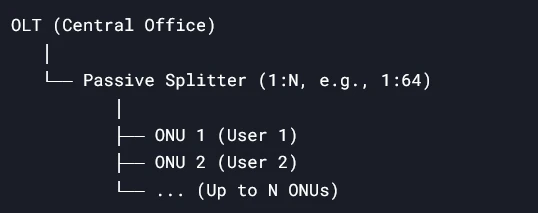
OLT: Aggregates traffic from multiple ONUs, manages bandwidth, and interfaces with the ISP core network.
ONU: Serves as the subscriber-side endpoint, converting optical signals for end-user devices.
Splitter: Passively divides optical power (no active electronics).
2. Downstream (OLT → ONU) Communication
(1) Broadcast Mechanism
The OLT transmits continuous downstream traffic (1490nm in GPON, 1577nm in XGS-PON) to all ONUs.
Encryption (AES-128 in GPON): Ensures only the intended ONU decrypts data (each ONU has a unique GEM Port ID).
(2) Frame Structure (GPON Example)
GTC (GPON Transmission Convergence) Frame:
Contains GEM (GPON Encapsulation Method) payloads (segmented into 125µs frames).
Embedded PLOAM (Physical Layer OAM) messages for ONU management.
(3) ONU Processing
Each ONU filters traffic based on its Alloc-ID (GPON) / LLID (EPON).
Decrypts and forwards data to connected devices (PC, router, VoIP phone).
3. Upstream (ONU → OLT) Communication
(1) TDMA (Time-Division Multiple Access)
Since all ONUs share the same upstream wavelength (1310nm in GPON, 1270nm in EPON), the OLT schedules timeslots to avoid collisions.
Dynamic Bandwidth Allocation (DBA):
OLT polls ONUs for buffer status reports.
Assigns transmission windows based on priority (e.g., VoIP > Internet > IPTV).
(2) Burst-Mode Transmission
ONUs must synchronize laser timing to avoid overlapping signals.
Ranging Process:
OLT measures each ONU's round-trip delay and compensates for fiber distance differences.
Ensures precise timeslot alignment (guard bands prevent interference)
(3) EPON vs. GPON Upstream
| Feature | GPON | EPON |
|---|---|---|
| Protocol | G.984 (ITU-T) | 802.3ah (IEEE) |
| Control | OMCI (ONU Management) | MPCP (Multi-Point Control Protocol) |
| Frame Type | GEM Encapsulation | Standard Ethernet |
4. OLT-ONU Management & Control
(1) ONU Registration & Authentication
Discovery Phase:
OLT detects new ONUs via serial number (SN) or LOID/Password.
Assigns an ONU-ID (GPON) or LLID (EPON).
Ranging & Calibration:
OLT measures fiber distance and sets equalization delay.
Service Provisioning:
OLT pushes VLAN, QoS, and firmware via OMCI (GPON) or OAM (EPON).
(2) Real-Time Monitoring
OLT Functions:
Monitors ONU status (optical power, temperature, uptime).
Detects faults (e.g., fiber cut, rogue ONU).
ONU Reporting:
Sends alarms (LOS, LOF, Dying Gasp).
5. Key Challenges & Solutions
| Challenge | Solution |
|---|---|
| Upstream Collisions | TDMA + DBA (OLT-controlled scheduling) |
| Security Risks | AES-128 (GPON), MACsec (EPON) |
| Fiber Distance Variation | Ranging & Equalization Delay Adjustment |
| Bandwidth Fairness | Priority Queuing (T-CONT in GPON) |
6. Practical Example: GPON Data Flow
User Requests a Web Page:
- ONU buffers the HTTP request, waits for its assigned upstream slot.
OLT Grants Transmission Window:
- ONU sends the request in a burst (1310nm).
OLT Forwards to Internet:
- Processes the request, returns data via downstream broadcast (1490nm).
ONU Filters & Delivers Data:
- Decrypts and routes the response to the user's device.
Conclusion: OLT-ONU Synergy
- OLT: The "brain" of PON-controls timing, bandwidth, and security.
- ONU: The "executor"-adapts optical signals for end-users and adheres to OLT directives.
- Passive Splitter: Enables cost-effective fiber sharing.


