Hey there! As a supplier of digital modulators, I often get asked about the difference between analog and digital modulators. It's a topic that's not only super important in the world of electronics but also has a huge impact on how we transmit and receive information these days. So, let's dive right in and break it down.
What Are Modulators Anyway?
Before we get into the differences, let's quickly go over what modulators do. In simple terms, a modulator is a device that takes an information signal (like audio, video, or data) and changes some property of a carrier signal to carry that information. Think of it like putting a message in a bottle and sending it out to sea. The carrier signal is the bottle, and the information signal is the message inside.

Analog Modulators: The Old School Way
Analog modulators have been around for a long time. They work by continuously varying a characteristic of the carrier signal, like its amplitude (AM - Amplitude Modulation), frequency (FM - Frequency Modulation), or phase (PM - Phase Modulation).
How AM Works
In AM, the amplitude of the carrier signal changes in proportion to the amplitude of the information signal. For example, if you're transmitting an audio signal, the louder the sound, the bigger the change in the carrier's amplitude. AM is commonly used in radio broadcasting, especially for long - distance communication. However, it's quite susceptible to noise. Any interference can distort the amplitude of the signal, which means you might hear crackling or static on your radio.
How FM Works
FM, on the other hand, changes the frequency of the carrier signal according to the information signal. The advantage of FM over AM is that it's more resistant to noise. Since noise usually affects the amplitude of a signal, and FM is based on frequency changes, it can provide a cleaner sound. That's why FM radio is often used for music stations, as it can deliver high - quality audio.
How PM Works
PM modifies the phase of the carrier signal. It's not as commonly used in consumer applications as AM and FM but has its uses in some specialized communication systems.
Digital Modulators: The New Kid on the Block
Digital modulators, like the ones we supply at [not adding made - up company name], work a bit differently. Instead of continuously varying a signal characteristic, they use discrete values to represent the information.
Binary Phase - Shift Keying (BPSK)
One of the simplest digital modulation techniques is BPSK. In BPSK, the phase of the carrier signal is shifted by 180 degrees to represent binary data. A 0 might be represented by one phase, and a 1 by the opposite phase. It's a very reliable method but has a relatively low data rate.
Quadrature Phase - Shift Keying (QPSK)
QPSK is an improvement over BPSK. It can represent two bits of data at a time by using four different phase shifts. This means it can transmit data at a higher rate compared to BPSK. QPSK is widely used in satellite communication and digital television broadcasting.
Quadrature Amplitude Modulation (QAM)
QAM is even more advanced. It combines both amplitude and phase modulation to represent multiple bits of data at once. For example, 16 - QAM can represent four bits per symbol, and 64 - QAM can represent six bits per symbol. This allows for very high - speed data transmission, which is crucial for applications like high - definition video streaming.
Key Differences Between Analog and Digital Modulators
Noise Resistance
As mentioned earlier, digital modulators are generally more resistant to noise than analog modulators. Since digital signals use discrete values, a small amount of noise is less likely to change the meaning of the data. In contrast, analog signals can be easily distorted by noise, which can lead to a loss of information.
Data Rate
Digital modulators can achieve much higher data rates than analog modulators. With techniques like QAM, it's possible to transmit large amounts of data in a short period. Analog modulators, on the other hand, are limited in their data - carrying capacity due to the continuous nature of the modulation.
Bandwidth Efficiency
Digital modulators are more bandwidth - efficient. They can pack more data into a given bandwidth, which is important in today's world where the demand for high - speed data transmission is constantly increasing. Analog modulators often require more bandwidth to transmit the same amount of information.
Cost and Complexity
Analog modulators are generally simpler and cheaper to manufacture. They have been around for a long time, and the technology is well - established. Digital modulators, however, are more complex and often require more advanced components and signal processing algorithms. But as technology has advanced, the cost of digital modulators has been coming down.
Our Digital Modulator Offerings
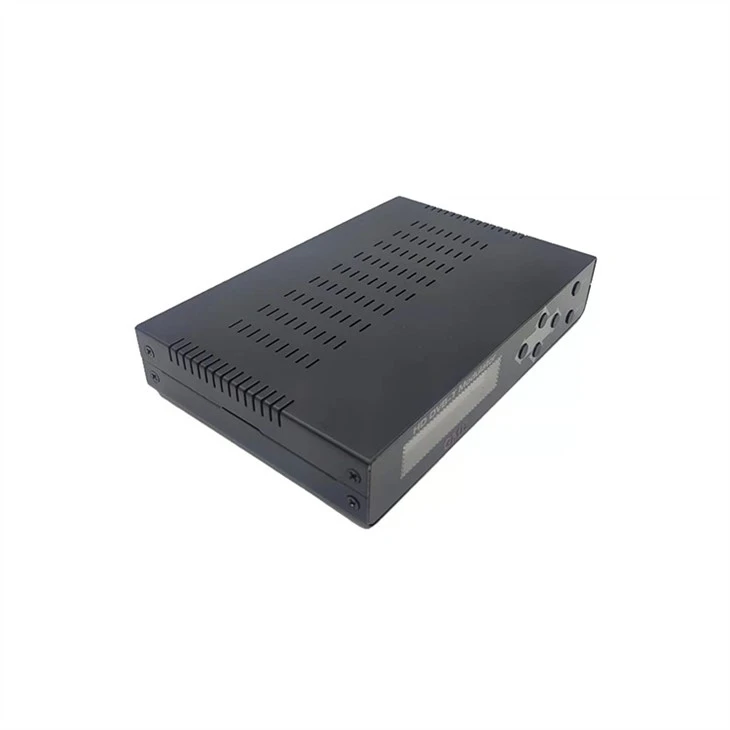
We offer a wide range of digital modulators to meet different needs. For example, our Digital Terrestrial HD Modulator is perfect for broadcasting high - definition television signals over the air. It provides excellent picture and sound quality, and it's very reliable.
If you need to transmit multiple channels of high - definition video, our 4 Channel HD QAM Modulator is a great choice. It can handle four channels at once, making it ideal for cable TV providers and other large - scale broadcasting applications.
And for those who need a modulator with an IR return path, our DVB - T Modulator with IR Return Path is the way to go. It allows for two - way communication, which is useful in interactive television systems.
Why Choose Digital Modulators?
In today's digital age, the advantages of digital modulators are clear. They offer better quality, higher data rates, and more efficient use of bandwidth. Whether you're a small business looking to set up a local radio station or a large media company broadcasting high - definition content, digital modulators are the way to go.
Let's Talk!
If you're interested in learning more about our digital modulators or are thinking about making a purchase, we'd love to hear from you. Contact us to start a discussion about your specific needs, and we'll work with you to find the perfect solution.
References
- "Communication Systems" by Simon Haykin.
- "Digital Modulation Techniques" by Bernard Sklar.