

A Comprehensive Guide to 10G Single-Mode Optical Module Transmission Distances: Standard Specifications, Detailed Look at the 2km Option, and Selection Tips to Avoid Pitfalls
In modern network transmission, optical modules are the core components connecting fiber optics to network devices. 10G single-mode optical modules, with advantages like fast transmission, strong anti-interference capability, and low loss, are widely used in scenarios such as campus networks and data centers. Transmission distance is the key indicator for selection. Many professionals often confuse the specifications – for example, what are the standard distances, does a 2km option exist, and how to match them to scenarios. This article will explain the core knowledge to help everyone avoid selection mistakes.
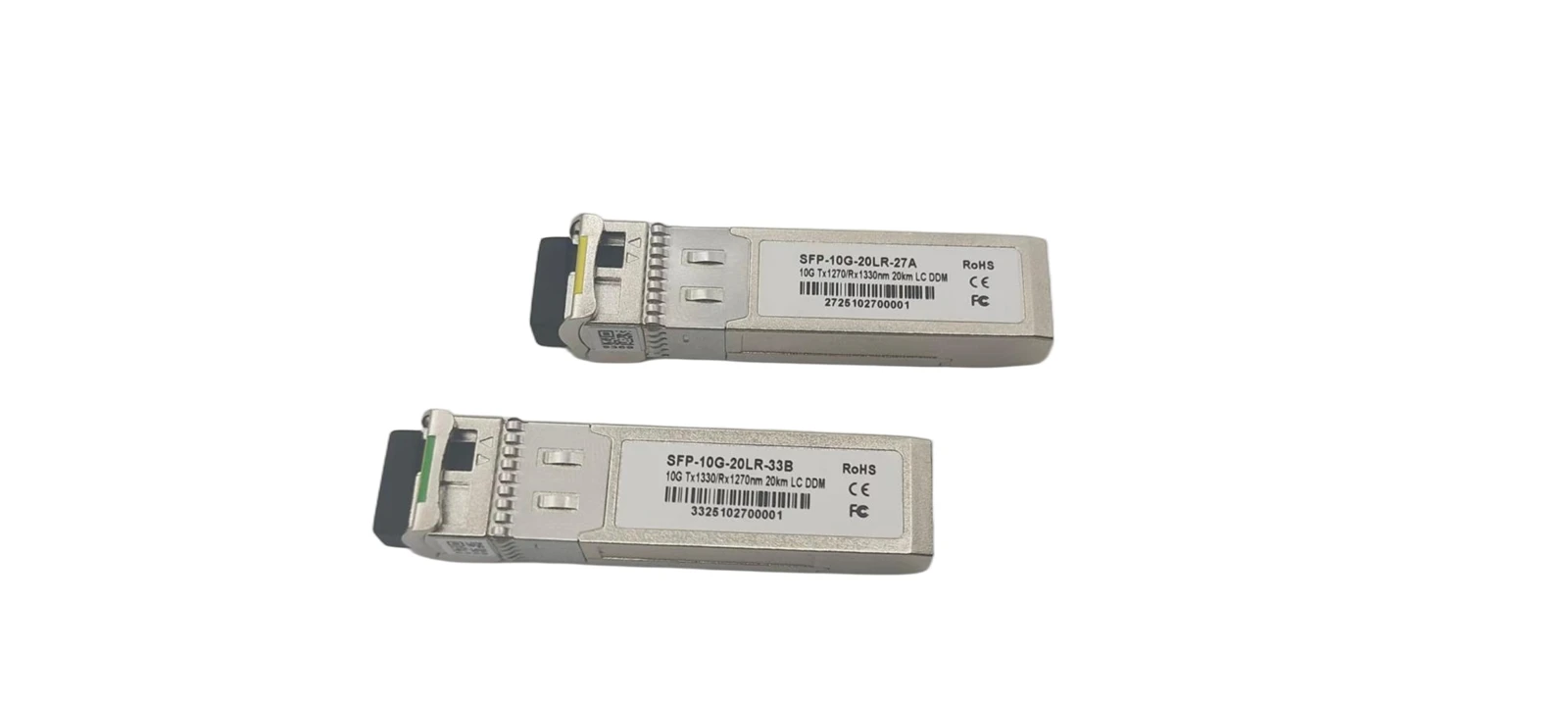
I. Basic Understanding of 10G Single-Mode Optical Modules
10G single-mode optical modules predominantly use the SFP+ package, compatible with devices like switches and servers, and must be used with 9/125μm OS2 single-mode fiber. The core of single-mode fiber is extremely thin, allowing only a single optical signal path, resulting in much lower loss compared to multimode fiber. This is key to achieving kilometer-level transmission distances.
Its transmission distance is affected by four main factors: optical wavelength, transmit power, receiver sensitivity, and fiber link loss. 1310nm and 1550nm are the mainstream wavelengths. Industry specifications follow IEEE international standards, forming clear distance tiers that balance performance and cost.
II. Mainstream Standard Transmission Distance Specifications for 10G Single-Mode Optical Modules
The mainstream distances for 10G single-mode optical modules on the market follow the IEEE 802.3ae standard. The four main specifications – 10km, 20km, 40km, and 80km – cover all common scenarios. Their characteristics are as follows:
10km Specification (10GBASE-LR): The Most Common and Cost-Effective Option
This is the most widely used standard specification with the best price-performance ratio. It has a transmission distance of 10km, uses the 1310nm wavelength, and is suitable for campus building interconnections and short-to-medium distance cabling in data centers. It offers strong compatibility and a mature supply chain, making it the first choice for most enterprises and the baseline for short-distance specifications.
20km Specification: Enhanced Medium-Distance Transition Option
This is not an IEEE base standard but an enhanced version of 10GBASE-LR. It also uses the 1310nm wavelength, extending the distance to 20km by optimizing power. It fills the gap between 10km and 40km, suitable for metro network access layers and cross-campus connections. It can interoperate with 10km modules, offering high flexibility.
40km Specification (10GBASE-ER): The Main Long-Distance Workhorse
This is a standard long-haul specification with a transmission distance of 40km. It uses the 1550nm wavelength (which has lower loss), making it suitable for metro network backbone layers and cross-regional interconnections. It typically doesn't require additional optical amplification equipment, costs less than 80km modules, and is the primary choice for long-distance transmission.
80km Specification (10GBASE-ZR): The Maximum Standard Long-Haul Option
This is the longest distance standard specification for 10G single-mode, offering 80km transmission. It uses the 1550nm wavelength and has very high hardware requirements. It is suitable for special scenarios like cross-city connections or remote base station backhaul. Costs are high, and power consumption is significant, so it should not be chosen unnecessarily for routine scenarios.
III. The Often-Overlooked 2km Specification: A Cost-Effective Choice for Short Single-Mode Links
Many people wonder if a 2km option exists for 10G single-mode. The answer is yes. It is not part of the IEEE 802.3ae base standard but is based on the 10GBASE-LRL specification within the IEEE 802.3aq standard. It's commonly referred to as the 10G SFP+ 2km single-mode module, a high-value option for short-distance scenarios.
This module typically uses the 1310nm wavelength and primarily features an LC duplex interface. Compared to 10km LR modules, it has lower transmit power and relaxed sensitivity requirements, resulting in a cost reduction of 10%-30%. It retains the anti-interference advantages of single-mode, filling the distance gap between 300m (multimode) and 10km (single-mode).
Its application scenarios include cross-rack cabling in data centers and short-distance campus interconnections. Compared to multimode modules, it transmits further and has stronger interference resistance. Compared to 10km modules, it has lower cost and power consumption. Compliant 2km modules can interoperate with 10km modules. When purchasing, prioritize products labeled as 10GBASE-LRL to ensure compatibility.
IV. Key Considerations for Selecting 10G Single-Mode Optical Modules
Selection must consider the scenario, cost, and compatibility comprehensively. Pay attention to the following 5 key points:
Choose Distance Based on Needs, Avoid "Longer is Better"
Blindly choosing longer-distance modules increases costs and can potentially cause signal overload. Accurately measure the distance, reserve a 10%-20% margin for link loss. Choose 2km LRL for distances under 2km, 10km LR for under 10km, 40km ER for 20-40km, and only consider 80km ZR for distances exceeding 40km.
Match the Fiber Type to Avoid Incompatibility
Must be used with OS2 single-mode fiber. Strictly avoid mixing with multimode fiber, as this will cause transmission errors. During deployment, follow standard cabling practices, minimize fiber bends and connectors, to reduce link loss.
Pay Attention to Standard Compliance
For mainstream specifications, prioritize products that comply with IEEE standards, ensuring compatibility with major equipment brands. Avoid non-standard, off-brand modules to reduce future maintenance troubles.
Weigh Cost and Performance
≤300m: Prioritize 10G SR multimode modules (lower cost).
300m-2km (with interference concerns): Choose 2km LRL.
Within 10km: Choose 10km LR.
Long distances: Choose 40km ER or 80km ZR as needed.
Industrial scenarios: Choose extended temperature models.
Indoor scenarios: Choose commercial grade.
Ensure Proper Optical Power Matching
When interconnecting modules of different specifications, check the optical power in advance. If the power is too high, add an attenuator to ensure the received power is within the receiver's sensitivity range, guaranteeing lossless packet transmission.
V. Conclusion: Suitability is Key
The four mainstream specifications for 10G single-mode optical modules – 10km, 20km, 40km, and 80km – cover the vast majority of scenarios, with the 2km LRL filling the short-distance gap. The core principle of selection is to match the scenario, align the distance, and balance the cost. Rejecting the misconception that "longer distance is better" is crucial to selecting the right module, ensuring network stability, and controlling costs.


