

WDM: Adding Lanes to One Fiber
Before understanding WDM, remember this analogy: a fiber is a highway, optical signals are vehicles, and wavelength is the lane. Ordinary transmission has only one lane, while WDM divides the fiber into multiple "lanes" by wavelength spacing - signals at different wavelengths travel in parallel without interfering with each other.
A WDM device consists of two parts:
MUX (Multiplexer): combines multiple wavelength signals into one fiber at the transmit end;
DEMUX (Demultiplexer): separates the wavelengths from one fiber at the receive end.
MUX/DEMUX are essentially a pair of passive optical components - no power supply, no maintenance, plug and play. This is the very source of WDM's cost-effectiveness.
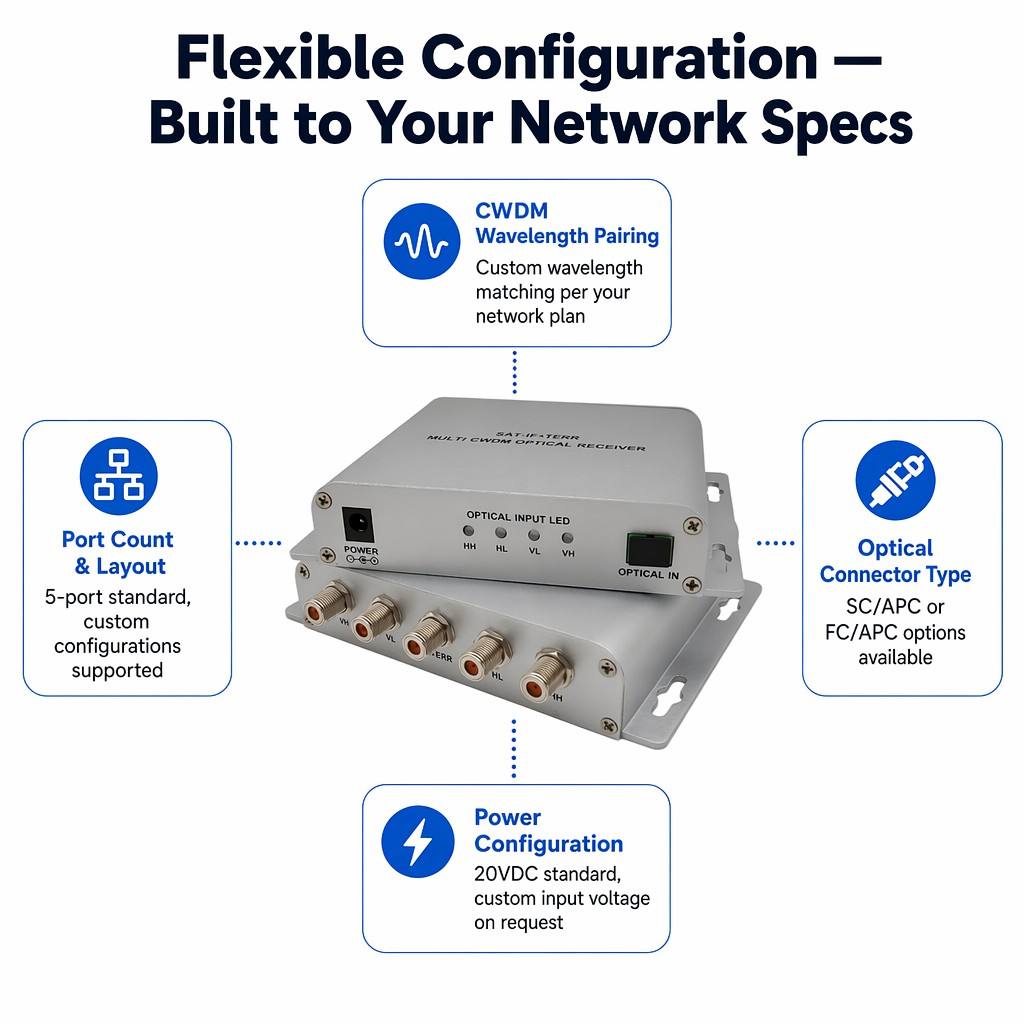
CWDM: The Standard Version
CWDM is one of the most widely deployed members of the WDM family.
Core characteristics: wide spacing, low cost
20 nm channel spacing: the industry-standard grid covers 1270~1610 nm for up to 18 channels (the common 8-channel plan uses 1470~1610 nm);
Uncooled lasers: the wide 20 nm spacing relaxes wavelength accuracy requirements, allowing low-cost uncooled DFB lasers (electronically tuned) without expensive TEC cooling and temperature control circuits;
Simpler device structure: wide spacing gives filters more design margin and higher yield, simplifying MUX/DEMUX structures and significantly cutting cost.
In contrast, DWDM (Dense WDM) uses only 0.4~1.6 nm spacing (50/100/200 GHz), cooled lasers, and can carry 8~160 wavelengths per fiber - with EDFA amplification enabling transmission over thousands of kilometers. But its cost is an order of magnitude higher.
|
Scheme |
Channel Spacing |
Laser |
Typical Use |
|
CWDM |
≥20 nm |
Uncooled |
Metro access, enterprise/campus networks, 5G fronthaul |
|
DWDM |
0.4~1.6 nm |
Cooled |
Long-haul trunks, high-capacity metro cores |
In one sentence: CWDM trades cost for coverage; DWDM trades capacity for distance. For access and aggregation scenarios within ~80 km, CWDM is the king of cost-effectiveness.
CCWDM: The Mini Version
CCWDM is the evolutionary form of CWDM - identical operating principle, completely rebuilt structure.
Core technology: TFF + free-space optics
CCWDM is also based on TFF (thin-film filter) technology, but the cascade method differs fundamentally from CWDM:
Standard CWDM: each wavelength channel's filter is linked by fiber - three-port filters cascaded in series, with internal fiber routing taking up significant space;
CCWDM: collimators and filters are mounted on a common substrate; adjacent channels cascade in free space via parallel beams in a "zigzag" path - the beam passes through the first filter to separate λ1, while the remaining light is reflected to the next filter for further separation, and so on, never entering fiber between stages.
Removing the cascade fibers delivers three direct benefits:
~10× smaller footprint: a typical 8-channel module measures only 44×28×6 mm (some 18-channel products reach 30×14.4×6.5 mm), versus standard CWDM 8-channel modules usually exceeding 100×80×10 mm;
Lower insertion loss: no repeated fiber splicing in the optical path - Ultra Low Loss grade achieves ≤1.0 dB (P grade ≤1.5 dB, A grade ≤2.0 dB), versus 2.5~3.5 dB typical for standard 8-channel CWDM;
Better channel uniformity: the symmetric free-space optical path gives consistent loss across channels, making link budgets easier to predict.
Key Specifications (8-channel example)
|
Parameter |
Typical Value |
|
Channel Count |
4 / 8 / 10 / 16 / 18 channels |
|
Center Wavelength |
1270~1610 nm (20 nm spacing) |
|
Insertion Loss |
≤1.0 dB (Ultra Low Loss grade) |
|
Adjacent Channel Isolation |
≥30 dB |
|
Non-adjacent Channel Isolation |
≥40 dB |
|
Return Loss |
≥45 dB |
|
Directivity |
≥55 dB |
|
Operating Temperature |
-40~+85°C (industrial grade) |
|
Dimensions |
44×28×6 mm typical (8 channels) |
CWDM vs CCWDM at a Glance
|
Item |
CWDM |
CCWDM |
|
Technology Base |
TFF thin-film filter |
TFF + Free-Space |
|
Channel Cascade |
Fiber cascade |
Parallel-beam free-space cascade |
|
Package Size |
Large (8ch ≈100×80×10 mm) |
~10× smaller (8ch ≈44×28×6 mm) |
|
Insertion Loss |
Higher (2.5~3.5 dB typical) |
Lower (down to ≤1.0 dB) |
|
Channel Uniformity |
Moderate |
Better |
|
Cost |
Low |
Even lower |
|
Bidirectional Use |
Supported |
Supported (same module as MUX or DEMUX) |
CCWDM is not a replacement for CWDM, but the preferred form for small-package, low-loss scenarios. The two share the same wavelength grid and are fully system-compatible - CCWDM can directly replace CWDM in new builds or high-density line cards.
Typical Application Scenarios
5G fronthaul and midhaul: Dense 5G base station deployment creates enormous fiber demand. CCWDM's small size, passive operation, and low cost make it ideal for tapping fiber resources at both AAU and DU sides - a single 6/8/12-channel module replaces multiple fiber cores.
Metro and access network expansion: Adding CWDM/CCWDM wavelengths over existing fiber multiplies bandwidth without breaking ground or laying new cable - widely used in carrier access layers and enterprise campus networks.
Data centers and DCI: With tight cabling space in data center interconnects and rack-to-rack links, CCWDM's ultra-compact package enables high-density patching.
OADM (Optical Add/Drop Multiplexing): CCWDM supports add/drop of specific wavelengths along backbone links without terminating all signals, reducing latency and equipment cost.
Conclusion
CWDM uses 20 nm spacing to achieve system-level low cost, making it the workhorse of access and aggregation expansion; CCWDM, on the same wavelength grid, uses free-space technology to shrink the package by 10× and push loss down to the 1 dB level - the standard version popularizes, the mini version perfects.
Selection guide:
Lowest cost with ample rack space → standard CWDM;
Small package, low loss, high-density deployment (5G fronthaul, embedded line cards, DCI) → CCWDM.
GOODMIND ELECTRONICS (SHENZHEN) LTD's GME brand offers a full line of CWDM/CCWDM mux/demux products covering 4~18 channels, with LC/SC/FC interfaces and industrial-grade temperature ratings - delivered end-to-end from components to system solutions. Visit www.rfgme.com to learn more.


