

Faced with the pain points of complex home network cabling and piled-up equipment, a terminal device integrating four functions is quietly changing the home broadband ecosystem.
In an era where Gigabit broadband has become mainstream, home networks face new challenges: optical modems, routers, telephone interfaces, and TV set-top boxes often clutter the living room, with complex cabling and maintenance difficulties. Recently, a GPON ONU device integrating four Gigabit Ethernet ports, VoIP, dual-band AC Wi-Fi, and CATV functions is becoming a market favorite.
This device, dubbed the "All-in-One Smart Optical Modem" by the industry, is solving the problem of piled-up home network equipment through highly integrated design, paving the way for the future of 10 Gigabit optical networks.
01 Industry Pain Points: Piled-up Equipment and Complex Cabling
Behind home broadband upgrades lies the chaos of multiple devices that users must contend with. The vast majority of Chinese households need to handle fiber optic internet, IPTV, fixed-line telephone, and Wi-Fi coverage simultaneously during broadband installation.
The traditional solution involves multiple standalone devices or a basic optical modem plus numerous external devices, leading to tangled cables and multiple points of failure.
Consumers need a terminal device that can integrate multiple functions with stable performance, and this all-in-one GPON ONU precisely meets this market demand.
During development, equipment manufacturers focused on solving the technical challenges of functional integration and signal interference, enabling a single device to handle different service streams simultaneously.
02 Technological Integration: Four Functions in One Design
Each of the four functions of this GPON ONU device has its unique technical requirements. The four Gigabit Ethernet ports meet the multi-room wired network needs, ensuring stable operation for high-bandwidth applications like gaming and office work.
The VoIP function uses a dedicated DSP chip to transmit voice data over the GPON network, delivering clear call quality and supporting additional features like caller ID and three-way calling.
The dual-band AC Wi-Fi technology operates on both 2.4GHz and 5GHz frequency bands, automatically selecting the optimal band to solve network lag caused by congestion on a single band.
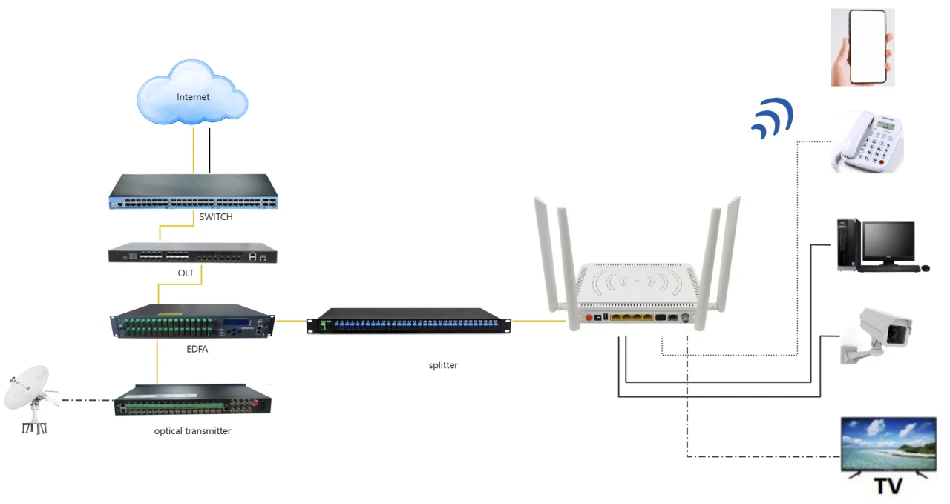
Most notably, the direct integration of the CATV function uses Wavelength Division Multiplexing (WDM) technology to transmit both internet data and broadcast TV signals over a single optical fiber.
This means users no need additional IPTV set-top boxes or complex video conversion equipment, and can directly watch HD TV programs through the home network.
03 Driving Force: 10G Optical Network and 50G PON Deployment
The rise of this converged device is closely related to the acceleration of China's 10G optical network construction. In early 2025, the Ministry of Industry and Information Technology (MIIT) issued the "Notice on Carrying out 10G Optical Network Pilot Projects," promoting pilot initiatives nationwide.
50G PON, as the next-generation optical access technology, is moving from the experimental phase to large-scale deployment. According to experts, 50G PON is a key enabling technology for 10G optical networks, with standards largely complete and the industry direction clear.
Driven by pilot policies, multiple provinces and cities including Beijing, Shanghai, Zhejiang, Jiangsu, Shandong, and Shenzhen have released 10G optical network development plans and policies.
Equipment manufacturers are proactively launching terminal devices supporting higher speeds. Li Mingsheng, Planning Chief Engineer at ZTE, stated that they have launched a new generation of intelligent computing OLT platform, coupled with the 50G PON FTTR product series, supporting 10G deployment across all scenarios including homes and campuses.
04 Market Trend: Home Network Integration
Industry data shows that Gigabit users already account for 30.9% of all fixed internet broadband users, reaching 207 million households. As user requirements for network quality increase, home network equipment is developing towards "integration, intelligence, and standardization."
China Unicom has built the Hi-CON home intelligent collaborative optical communication system, promoting the convergence of heterogeneous networks and extending carrier-grade operational experience into the home.
Meanwhile, China Mobile is also building an FTTR+PON end-to-end centralized management and control architecture, improving the ultra-gigabit Wi-Fi experience guarantee through platform centralized management and control, and optical + WLAN collaboration.
Whole-home optical Wi-Fi (FTTR) is becoming a new trend, using optical fiber to extend the network to every room, solving Wi-Fi coverage challenges in large residences.
Against this backdrop, the all-in-one GPON ONU device becomes the core control hub of the home network, simplifying user operations through unified management.
05 Challenges and Future: Smooth Evolution to 10G
Although the all-in-one GPON ONU device solves many current pain points of home networks, the industry still faces technical challenges. During the evolution towards 10G optical networks, GPON and EPON regions face different upgrade paths.
In GPON regions, the three-generation coexistence scheme of G/XG(S)/50G is progressing smoothly overall, with industry standards largely complete. However, in EPON regions, the main challenge for upgrading to 50G PON is the overlap between the upstream wavelength and the ITU-T 50G PON upstream/downstream wavelengths.
The industry is actively promoting solutions. ZTE released a 50G-PON three-generation Time Division coexistence scheme, overcoming the industry challenge of compatibility between ITU 50G-PON and IEEE EPON standards.
The China Telecom Research Institute and ZTE jointly completed the laboratory verification of the 50G-PON three-generation Time Division coexistence technology scheme.
Equipment manufacturers have also made breakthroughs in optical module miniaturization. The China Telecom Research Institute, together with industry partners, completed for the first time the laboratory verification of an asymmetric rate SFP-DD miniaturized "tri-mode coexistence" 50G-PON OLT optical module and system.
With the launch of national 10G optical network pilot projects, functional integration of equipment will become the mainstream trend for home terminals. According to industry predictions, by 2025, 25G/50G PON OLT optical modules will account for 30% of the PON OLT market.
Future home networks will be more concise and intelligent, with a single optical fiber entering the home and connecting to a small device, meeting all the network needs of the entire household.
All-optical + AI is helping smart home services expand from the "old three items" – broadband internet, TV IPTV, and home security – to the "new three items" – home storage, XR fitness/gaming, and home care for the elderly.


