

In scenarios such as hotels, senior living communities, Multi-Dwelling Units (MDUs), and historically preserved buildings, operators often face a thorny problem: tenants and guests have a growing demand for high-speed broadband, smart devices, and IoT applications, yet the building's physical infrastructure is long obsolete. Traditional network upgrade solutions often entail "breaking through walls and digging holes" and large-scale rewiring, which is not only costly and time-consuming but also severely disrupts normal operations and the living experience. The emergence of G.hn technology provides a near-perfect solution to this dilemma.
I. What is G.hn Technology?
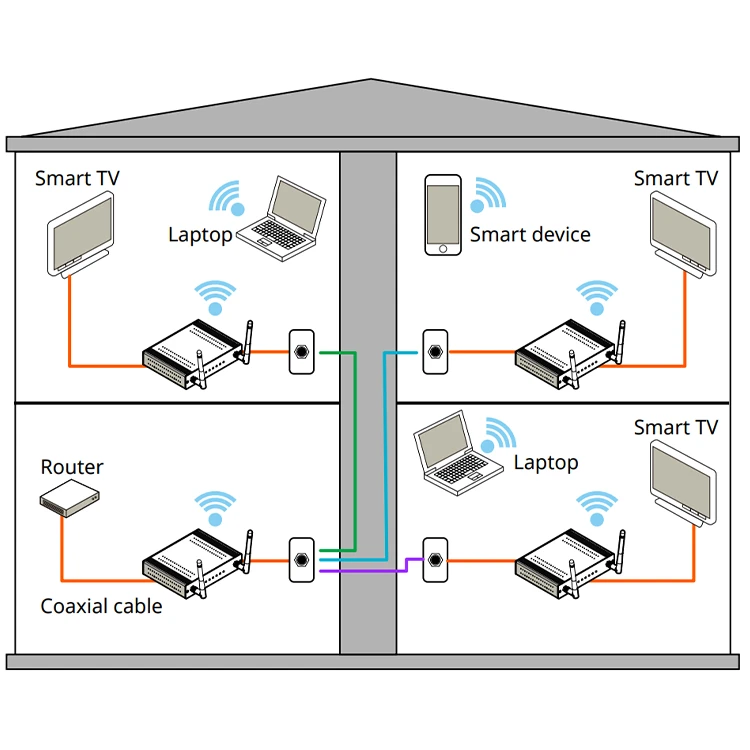
G.hn, short for Gigabit Home Networking, is a unified global standard developed by the International Telecommunication Union (ITU). The core value of this technology lies in its ability to utilize any existing wired lines within a building – whether they are coaxial cables, telephone twisted pairs, or even power lines – to build a high-speed, stable, and reliable gigabit network.
In simple terms, G.hn technology can instantly transform old "copper wire" infrastructure into a transmission channel capable of carrying fiber-grade bandwidth, without the need to replace every inch of wiring.
II. Core Advantages: Why Do Old Buildings Need G.hn?
For buildings constructed 15-20 years ago or even earlier, the internal coaxial or copper cabling was only designed to meet the needs of cable TV or low-speed ADSL internet at the time. G.hn technology completely changes this situation through the following four core advantages:
1. Extreme Cost Control, Significant Reduction in Capital Expenditure
The cost of traditional rewiring is extremely high. According to industry data, the average cost of a traditional rewiring project ranges from $600 to $1200 per unit, not including additional expenses like subsequent wall repairs and repainting. By adopting G.hn technology, since no new wiring is required and installation is primarily based on equipment replacement, the overall cost is typically only about one-third of that of a traditional rewiring solution. Other data shows that compared to pure Fiber-to-the-Home (FTTH) installations, the cost of a G.hn solution can be reduced by more than 10 times, with equipment costs per room potentially as low as $8.
2. Non-Invasive Installation, Protecting Building Structure and Operations
For hotels, nursing homes in operation, or apartment buildings with high occupancy rates, the noise, dust, and personnel traffic caused by construction are the biggest headaches for owners and managers. Traditional rewiring projects can last for months, severely impacting guest experience and daily operations. The installation of G.hn devices is extremely simple and fast, typically allowing for full-building deployment within days to weeks, and even the activation of a single terminal can be completed within one hour. This "zero-touch" characteristic is particularly important for historically protected buildings, as it avoids irreversible damage to the main building structure caused by drilling through walls and floors.
3. Quantum Leap in Performance, Meeting Modern Application Demands
Old wiring does not equate to low speed. G.hn technology can achieve physical layer transmission rates of up to 1.7 Gbps, and even 4-8 Gbps in the future, based on existing telephone lines or coaxial cables. This means it can easily support:
4K/8K Streaming and Cloud Gaming: Meeting top-tier entertainment needs in guest rooms and homes.
Remote Work and Video Conferencing: Providing a stable connection with low latency and no lag.
Smart Home and IoT: Fully supporting voice control, building automation, environmental sensors, and other devices.
Smart Senior Care Applications: Ensuring the real-time and reliable transmission of critical data such as emergency calls, fall detection, and telemedicine.
4. High Reliability and Scalability
G.hn technology possesses strong anti-interference capabilities, with a transmission distance exceeding 100 meters, ensuring signal stability even in complex multi-story buildings. Furthermore, it supports connecting up to 16 nodes and features automatic path identification and self-healing functions similar to mesh networks. When new units or services need to be added in the future, the network can be easily expanded without the need for secondary infrastructure renovation.
III. Typical Application Scenarios
Hotel Industry: Many boutique hotels and resorts are located in old buildings and cannot afford the losses from closing down for construction. G.hn utilizes the existing coaxial cables for cable TV in guest rooms to provide high-speed Wi-Fi and IPTV services, enhancing guest satisfaction.
Senior Living Communities: Without the need for complex construction inside residents' homes, high-speed networks covering both public areas and private residences can be deployed throughout the community, supporting wearable devices and telemedicine.
Multi-Dwelling Units (Apartments/Dormitories): Solves the problem of being unable to pull new fiber optic cables through conduits that are too narrow, providing tenants with a high-speed internet experience comparable to fiber optics and increasing property value.
G.hn technology is not just a network transmission protocol; it is a green, efficient, and intelligent concept for infrastructure renewal. It cleverly bypasses the "hard nut" of physically renovating old buildings by tapping into the potential of existing resources, achieving a "soft landing" for modern digital life. For building owners who wish to complete their digital transformation and upgrade while controlling budgets and minimizing disruption, G.hn is undoubtedly one of the most worthy technical solutions to consider.


