

The global smart home networking market is undergoing a silent revolution. Coaxial cable – a long-overlooked home infrastructure – is being revitalized by MoCA 2.5 technology, offering consumers an upgrade path to whole-home gigabit coverage without the need for drilling walls or running new wires. According to market research, the global coaxial cable market is projected to grow to $46 billion by 2029, at a compound annual growth rate of 5.9%. Behind this growth, the continuous evolution of MoCA 2.5 technology has played a key role.
From "Old Wiring" to "Gigabit Backbone"
MoCA (Multimedia over Coax Alliance) technology allows existing in-home coaxial cable networks to carry high-speed Ethernet data. The latest MoCA 2.5 standard achieves actual MAC-layer data throughput of up to 2.5 Gbps, with end-to-end latency below 5 milliseconds – and in many real-world tests, as low as 2 to 3 milliseconds. This performance makes coaxial networks comparable in bandwidth to traditional Cat 6 Ethernet cabling, while offering far better penetration through brick walls and other complex building structures than Wi-Fi.
Major global operators have long recognized this technological potential. Leading North American service providers such as Verizon and Comcast have already deployed MoCA as a standard in-home networking solution alongside their fiber-to-the-home deployments, ensuring that fiber signals can be distributed to every room without loss.
Market Players Ramp Up, Product Ecosystem Matures
In May 2026, ASUS officially launched the MA-25 Coax-to-Ethernet MoCA adapter. This product supports 2.5 Gbps wired backhaul connections, features an easy band‑mode switching function to avoid signal interference with DOCSIS 3.1 cable modems, and includes MPS one‑touch secure encryption pairing. In terms of design, the MA-25's enclosure uses 69% post‑consumer recycled plastic, and the 2.5GbE Ethernet port enables near-lossless whole-home mesh networking performance in wired backhaul scenarios.
Around the same time, Motorola introduced the MM1025 MoCA 2.5 adapter, also featuring a 2.5 Gbps Ethernet port and focusing on plug‑and‑play multi‑gigabit connectivity. ScreenBeam's ECB7250 bonded MoCA 2.5 adapter is the industry's first MoCA adapter equipped with a 2.5 Gigabit Ethernet port, delivering true multi‑gigabit full‑duplex speeds, backward compatibility with MoCA 2.0/1.1/1.0, support for up to 16 MoCA nodes, and simultaneous transmission of cable TV signals and high‑speed network data. TRENDnet released the TMO-312C2K kit containing two adapters, compliant with NDAA/TAA requirements to meet both security and performance needs for government users. User tests show that in a 2.5GbE network environment, transferring hundreds of gigabytes of large files between devices via a MoCA 2.5 adapter takes less than five minutes – performance nearly indistinguishable from native Ethernet.
Installation Barriers Lowered, Application Scenarios Expand
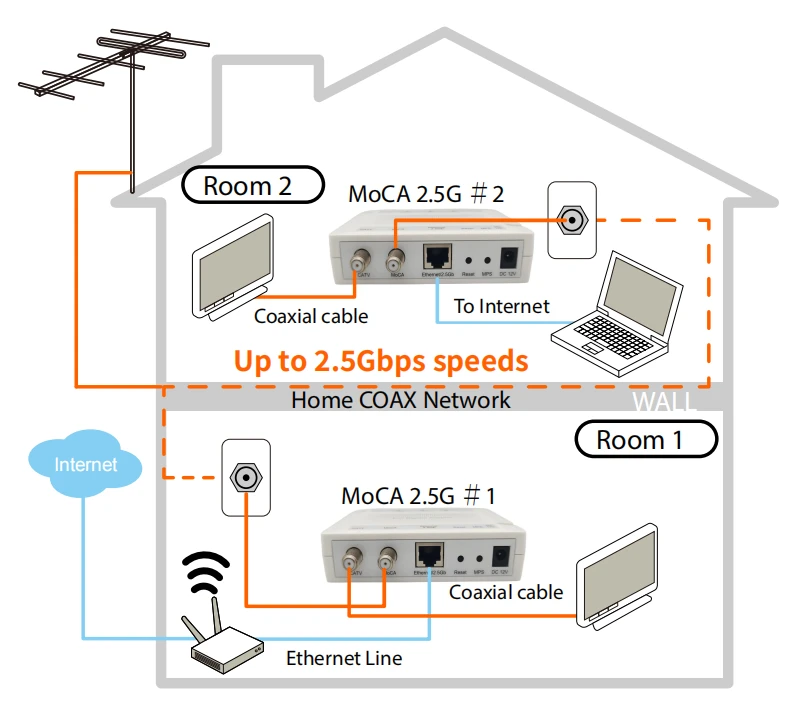
From a technical implementation perspective, the installation process for MoCA 2.5 adapters is extremely simple. Users only need to connect the first adapter to their router and to a coaxial outlet, then install a second adapter in the target room and connect the end device – the entire process typically takes less than 10 minutes. This solution requires no professional electrician or wall drilling, significantly lowering the barrier for home users to upgrade their networks. Leveraging this advantage, MoCA 2.5 is rapidly penetrating multiple high‑bandwidth applications including 4K/8K ultra‑HD streaming, low‑latency online gaming, remote work video conferencing, and wired backhaul for mesh Wi‑Fi. Real‑world tests show that when MoCA 2.5 replaces wireless backhaul in mesh routers, the wired bandwidth loss between routers is virtually negligible.
Expanding Beyond the Home
MoCA 2.5 applications have already extended beyond the consumer home market into commercial and operator spaces. In 2025, the MoCA Alliance released the MoCA Access 2.5 eQoS (enhanced Quality of Service) amendment, introducing fine‑grained dynamic bandwidth allocation with priority management for network traffic, effectively solving bandwidth assurance issues during peak hours in multi‑dwelling units (MDUs). On the deployment front, the city of Elberton, Georgia, USA, has deployed a MoCA Access 2.5 solution from Nokia and InCoax, using existing in‑building coaxial cables to deliver gigabit broadband coverage in older MDUs where fiber‑to‑the‑home is not feasible.
Outlook and Future
While MoCA 2.5 has certain compatibility limitations – it does not support satellite TV systems such as DirecTV or Dish Network, and may have frequency overlap issues with some older DOCSIS 3.1 cable modems – its unique "no new wires, no drilling" upgrade path, combined with increasingly mature encryption security mechanisms (MoCASec point‑to‑point link encryption), is positioning it as a highly competitive alternative to the increasingly crowded Wi‑Fi spectrum. As high‑bandwidth applications such as 8K video, AR/VR, and edge computing become more widespread, MoCA 2.5 is expected to further consolidate its key role in the post‑fiber home networking ecosystem in the years ahead.


