

Introduction
Fiber optic technology has revolutionized the way we communicate, offering unparalleled speed, reliability, and bandwidth. At the heart of this transformation lies the Optical Line Terminal (OLT), a critical component in Passive Optical Networks (PON). But what exactly is an OLT, and why is it so essential in modern telecommunication infrastructure?
In this blog post, we'll explore the role of OLTs, how they function, and why they are considered the gateway to next-generation fiber optic networks.
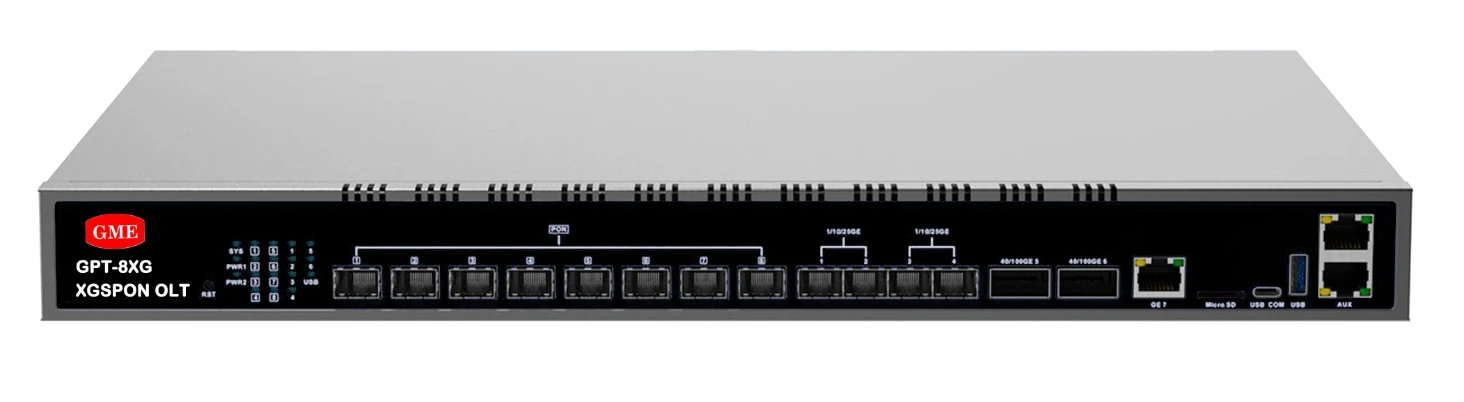
What is an OLT?
An Optical Line Terminal (OLT) is a device that serves as the service provider's endpoint in a Passive Optical Network (PON). It connects to multiple Optical Network Units (ONUs) or Optical Network Terminals (ONTs) at the customer's premises, enabling high-speed data, voice, and video transmission over fiber optic cables.
Key Functions of an OLT:
Signal Conversion – Converts electrical signals from the service provider's network into optical signals for fiber transmission.
Traffic Management – Controls upstream and downstream data flow between the central office and end users.
Bandwidth Allocation – Dynamically distributes bandwidth to connected ONUs/ONTs for efficient data transfer.
Security & Authentication – Ensures secure communication by encrypting data and verifying connected devices.
How Does an OLT Work?
A typical PON architecture consists of:
OLT (at the ISP's central office)
Optical Splitter (passive device distributing signals)
ONU/ONT (at the user's location)
Data Flow in a PON:
Downstream Transmission – The OLT broadcasts data to all ONUs via a single optical fiber. Each ONU filters and processes only the data intended for it.
Upstream Transmission – ONUs send data back to the OLT in designated time slots, preventing signal collisions.
This point-to-multipoint structure makes PONs highly efficient, reducing infrastructure costs while delivering gigabit-speed internet.
Why OLTs Are the Future of Fiber Communication
High-Speed Connectivity – Supports Gigabit and even 10G PON (XGS-PON) technologies, meeting growing bandwidth demands.
Scalability – A single OLT can serve hundreds of users, making it ideal for ISPs expanding their fiber networks.
Energy Efficiency – Unlike traditional copper-based systems, PONs with OLTs consume less power.
Future-Proof Infrastructure – OLTs are compatible with emerging technologies like 5G backhaul and IoT networks.


