

A 2026 bill of materials for a 10 km 100G link still shows 100GBASE-LR4: four NRZ lanes, four LAN-WDM wavelengths, one duplex LC pair. Beside it sits 100GBASE-DR: one PAM4 lane, one fiber pair, 500 m. Both are current, orderable, and specified in IEEE 802.3.
That is unusual; every other Ethernet rate settled on one physical-layer family within a few years. 100G did not, for reasons of lane arithmetic that still shape three things on every deployment: FEC configuration, the management interface, and fault localization.
The Lane Arithmetic That Locked NRZ In
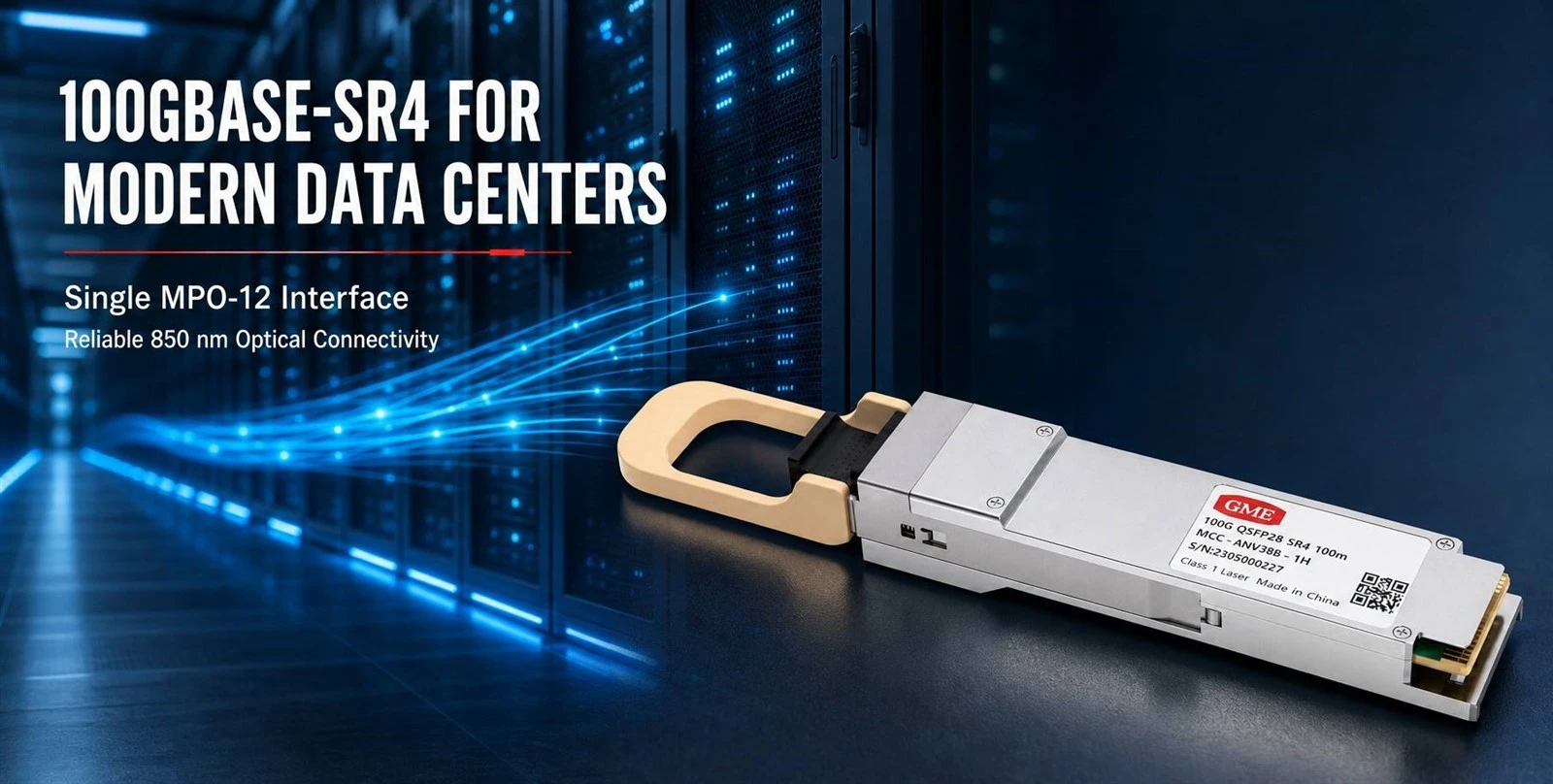
IEEE 802.3ba defined 100G in 2010 as four lanes at 25.78125 GBd with 64b/66b coding, a 103.125 Gb/s line rate for a 100 Gb/s MAC. Four lanes of a proven 25G NRZ cell were cheaper than a 50G cell that did not yet exist. NRZ also reached 1e-12 without FEC using DMLs, EMLs, and VCSELs: 802.3bm specifies SR4 in clause 95 and LR4 in clause 88 at that ratio, with no coding layer in the path.
PAM4 creates three eyes, costing roughly 9.5 dB of signal-to-noise ratio against NRZ at equal symbol rate ideally. Recovering it requires linear drivers, DSP equalization, and FEC. IEEE 802.3cd defines 100GBASE-DR as a single 53.125 GBd lane with TDECQ limited to 2.5 dB and RS(544,514) correction.
|
Parameter |
25G NRZ lane, 100GBASE-LR4 |
100G PAM4 lane, 100GBASE-DR |
|
Transmitter metric |
TDP, 2.2 dB max |
TDECQ, 2.5 dB max |
|
FEC |
None at 1e-12 |
RS(544,514) required |
|
In-module DSP |
No |
Yes |
|
Lasers per 100G port |
4 |
1 |
Where the Cost Actually Sits
CWDM4 modules use four uncooled DFB lasers on the 1271, 1291, 1311, and 1331 nm grid, multiplexed by an AWG into one duplex LC pair, at 3.5 W maximum under the 100G CWDM4 MSA Rev. 1.1. That MSA requires the host to enable RS(528,514) and specifies 5x10⁻⁵ pre-FEC BER: 25G DML over 2 km leaves too little dispersion margin to run uncoded.
LR4 is the uncoded case. Clause 88 gives a 6.3 dB budget over 10 km, launch power of -4.3 dBm to +4.5 dBm, receiver OMA sensitivity of -8.6 dBm, and a transmitter and dispersion penalty limit of 2.2 dB. All of it is verifiable with a source and power meter, which is why LR4 survived: the acceptance test is optical.
PAM4 wins where fiber is the constraint. A DR port uses one fiber pair, has a 3.0 dB insertion loss limit, and drops the mux. Against an 8-fiber SR4 or PSM4 link that is decisive; against a duplex LR4 it only removes the mux.
|
Variant |
Lanes and fiber |
Limit to remember |
|
100GBASE-SR4 |
4x25G NRZ, MPO-12 |
100 m OM4, 1.9 dB channel loss |
|
100G CWDM4 |
4x25G NRZ, duplex LC |
2 km, 3.5 W, RS(528,514) mandatory |
|
100GBASE-LR4 |
4x25G NRZ LAN-WDM |
10 km, 6.3 dB budget, no FEC |
|
100GBASE-DR |
1x100G PAM4, duplex LC |
500 m, TDECQ 2.5 dB |
Three Configuration Consequences
FEC is a property of the optic, not of the port speed. One 100G switch may run an LR4 that expects no FEC, a CWDM4 that will not work without RS(528,514), and a CR4 DAC covered by clause 91. Passive copper follows the same rule: IEEE 802.3bj assemblies up to 2 m are CA-25G-N and run uncoded; 3 m to 5 m assemblies are CA-25G-L and require FEC. Copying a FEC policy between 100G ports reliably builds a link that never comes up.
Management differs too. QSFP28 100G modules are managed through SFF-8636 with diagnostics in the A0h pages; QSFP-DD and OSFP use CMIS 5.x. A CMIS-based polling script reads a QSFP28 quietly wrong, returning zeros rather than an error.
Fault isolation granularity is the third difference. A four-lane NRZ module exposes four transmitters and four receivers, so one contaminated MPO fiber appears as one degraded channel. Single-lane DR removes that split: you get FEC counters and one receive power reading, which confirms a problem but not the connector to clean.
Field Symptoms and Check Order
|
Symptom |
Check first |
Usual root cause |
|
Down right after an optic swap |
FEC mode on both ends |
Policy inherited from the old optic |
|
Errors only at full load |
Pre-FEC BER, Rx power |
Margin exhausted, dirty end face |
|
Errors on about a quarter of traffic |
Per-lane diagnostics, MPO polarity |
One of four NRZ lanes |
Identify the exact standard variant from the label. LR4, CWDM4, DR, and SR4 have different FEC and reach rules.
Read diagnostics before touching hardware: temperature, voltage, Tx bias, Tx and Rx power.
Compare FEC settings on both ends. RS(528,514), RS(544,514), and off are three different links.
Measure span loss with a source and power meter, including panels and adapters, and compare it to the budget for that variant.
Inspect and clean every end face, then re-read Rx power. A 1 dB recovery is a contamination finding; re-qualify the link.
Swap hardware last, cheapest element first: cord, then module, then port.
Roadmap: Where 25G NRZ Still Earns Its Place
PAM4 has no reach gap at 100G. IEEE 802.3cd covers 500 m with DR; IEEE 802.3cu covers 2 km and 10 km with FR1 and LR1, both single-lane at 53.125 GBd. Greenfield builds increasingly specify these instead of mux optics.
NRZ survives on three things. Uncoded 10 km links with 6.3 dB of budget stay easy to certify with optical test gear. The QSFP28 installed base is enormous and fully specified. And power now binds at the top of the network: 400G DR4 modules draw roughly 8 W to 9 W, 800G modules sit near 16 W per port, so a 3.5 W 100G NRZ port is still the cheapest to cool at the edge.
The design conclusion is narrow. Do not build a new ASIC interface around 25G NRZ SerDes, because the roadmap above 400G is 100G and 200G per lane PAM4. Do keep LR4 and SR4 in spares planning while the installed base runs, and qualify DR or FR1 wherever fiber count or panel density is the real constraint.
Key Takeaways
100G was defined as four 25.78125 GBd NRZ lanes under IEEE 802.3ba, and 802.3bm SR4 and LR4 still reach 1e-12 without FEC.
PAM4 halves the lane count but adds a DSP, linear optics, TDECQ testing, and mandatory FEC, so it wins on fiber count, not automatically on cost.
FEC is per-optic: CWDM4 needs host RS(528,514) at 5x10⁻⁵ pre-FEC, LR4 needs none, CR4 uses clause 91.
QSFP28 100G is managed by SFF-8636, not CMIS; tooling must handle both register maps.
Four-lane NRZ gives per-lane diagnostics that single-lane DR cannot, which changes how you localize a bad fiber.


