

Fiber to the Home (FTTH), as a core method in the current broadband access field, has become the foundational communication support of the digital era primarily because it fundamentally addresses many pain points of traditional access methods. It not only meets the high-demand networking requirements of today but also supports the continuous evolution of future technologies and applications. This advantage is reflected in practical usage, long-term operation, and scenario adaptability, making it a truly "once-and-for-all" communication infrastructure solution.
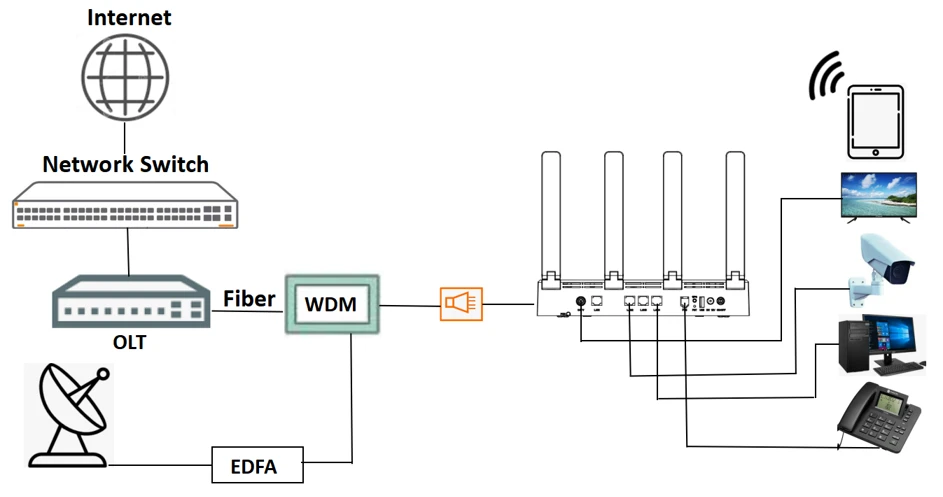
In terms of practical user experience, the core advantage of FTTH lies in its exceptional transmission performance. Unlike traditional methods such as ADSL and coaxial cables, fiber optics use light signals as the transmission medium, enabling a single fiber to easily achieve symmetric upload and download speeds of gigabits or even tens of gigabits per second. This completely eliminates the bottleneck of "fast download, slow upload" associated with traditional access methods. Whether it's multiple devices streaming 4K/8K ultra-high-definition videos simultaneously, playing cloud games, uploading large files to cloud storage, or conducting high-definition video conferences, FTTH ensures smooth and uninterrupted performance. Concurrent usage across multiple devices does not lead to bandwidth contention. Additionally, the transmission latency of light signals is extremely low, with single-trip latency controllable within 1 millisecond, and the bit error rate is as low as 10^-12. For scenarios requiring high real-time performance, such as online gaming and high-frequency financial trading, this level of stability is unmatched by traditional access methods. Furthermore, fiber optics, being non-conductive, are immune to electromagnetic interference from lightning, power lines, or radio-frequency signals. Signal attenuation is minimal, at only 0.2 decibels per kilometer, ensuring stable signal quality even over long distances. Unlike copper cables, fiber optics do not suffer from crosstalk or aging-induced speed fluctuations and can operate reliably in harsh environments with high temperatures, humidity, or corrosion, delivering unparalleled network stability and smoothness.
From the perspective of long-term usage and operation, the cost-effectiveness and scalability of FTTH are particularly outstanding. The physical properties of fiber optics enable a service life of over 30 years. Once the initial fiber installation is completed, future bandwidth upgrades only require replacing terminal equipment such as the Optical Line Terminal (OLT) at the central office and the Optical Network Unit (ONU) at the user end, without the need to re-lay fiber lines. This means a single installation can support bandwidth upgrades for decades, from gigabits to tens of gigabits per second and beyond, enabling smooth transitions through equipment upgrades. This perfectly accommodates the development of future high-bandwidth applications like the Internet of Things (IoT) and the metaverse, truly achieving "one-time investment, long-term benefits." In terms of operation and maintenance, FTTH utilizes a Passive Optical Network (PON) architecture, where the outdoor optical distribution network requires no additional power supply, significantly reducing outdoor failure points. Compared to traditional copper cable networks, the failure rate can be reduced by over 90%, greatly decreasing the workload for daily inspections and troubleshooting by maintenance personnel. Overall operational costs can be reduced to one-third of those associated with traditional copper cables. Moreover, FTTH systems are more mature in remote diagnostics and automated operation and maintenance, enabling quick fault localization and timely resolution, further reducing manual maintenance costs. For both operators and users, long-term usage costs are effectively controlled.
Beyond this, the environmental adaptability and scenario compatibility of FTTH make its advantages more universal. For ordinary households, it supports the full-scale implementation of smart homes, ensuring timely and lossless data transmission even when dozens of smart devices such as cameras, appliances, and sensors are connected simultaneously, enabling truly digital homes. For enterprises and small to medium-sized businesses, it provides communication reliability comparable to dedicated lines, with symmetric high bandwidth meeting daily collaboration and data exchange needs, all at lower costs and with more convenient maintenance compared to traditional dedicated lines. For urban development, FTTH, as a foundational infrastructure for smart cities, allows multiple operators to share fiber lines, avoiding resource waste from redundant installations and fostering service competition among operators, thereby driving improvements in network service quality and cost-effectiveness. For the real estate sector, residential and commercial properties equipped with FTTH can achieve asset appreciation through superior communication infrastructure, becoming a significant value-added feature in modern property offerings.
Compared to other access methods such as ADSL, coaxial cables, and 5G wireless broadband, FTTH offers comprehensive advantages. Its bandwidth ceiling far exceeds that of other methods, with symmetric upload and download capabilities, whereas traditional copper and coaxial cables have limited bandwidth ceilings. While 5G wireless broadband can achieve gigabit speeds, it relies on shared bandwidth, making it prone to speed fluctuations during peak hours. In terms of latency and stability, fiber optics offer uniquely low latency and low bit error rates, whereas wireless broadband is susceptible to base station coverage and signal interference, making latency and stability less reliable. Copper cables are easily affected by environmental factors and aging. In terms of long-term costs, fiber optics require only a one-time installation for long-term benefits, whereas copper and coaxial cables age quickly and require frequent maintenance and replacement. Wireless broadband demands ongoing investment in base station construction and signal optimization, resulting in higher overall costs.
Ultimately, the core value of FTTH lies in its architecture of "fiber directly to the user terminal," which fundamentally addresses the bandwidth bottlenecks, stability issues, and limited scalability of traditional access methods. It not only supports the foundation of today's digital homes, remote work, and online entertainment but also serves as the core communication infrastructure for the future development of smart cities, the digital economy, and the Internet of Things. This technological advantage of solving problems at the foundational level makes FTTH an irreplaceable choice in the broadband access field.


