

If you're like me, with simultaneous work-from-home meetings, children's online classes, a partner's 4K streaming, and various smart home devices, then you definitely understand what a "network civil war" is. Last month, when I froze into a slideshow for the Nth time during a video conference while the living room echoed with the loading spinner of Squid Game, I knew it was time to solve the problem for good.
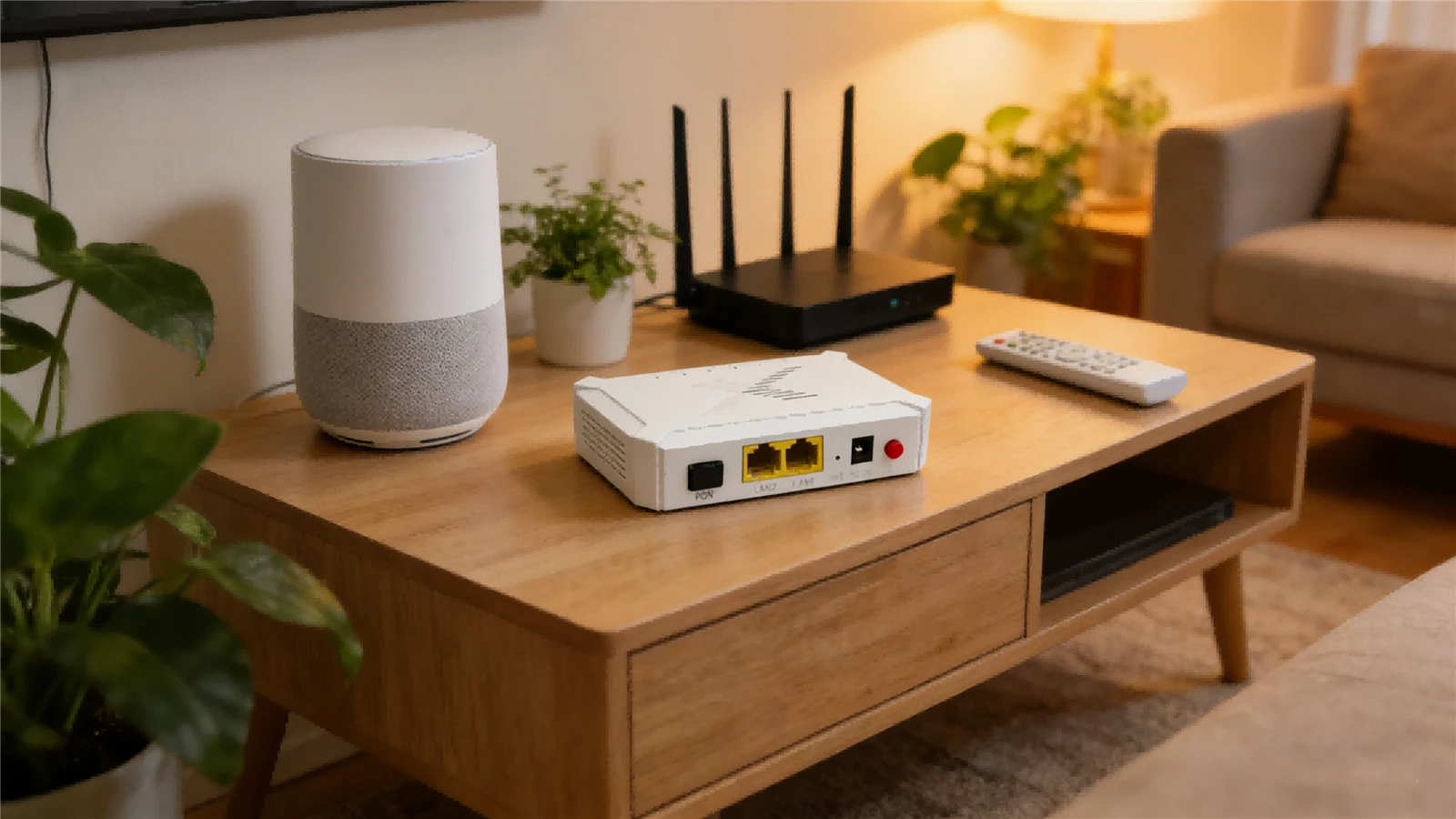
My home network infrastructure wasn't outdated-a Gigabit fiber optic line from the telecom provider had long been installed. The problem lay with the old device connecting the optical modem to various rooms. It wasn't until the installation technician recommended and helped me replace it with a 1GE 1FE ONU that the entire home network truly "came to life.
My Core Pain Points and Its Targeted Solutions
Scenario 1: Absolute Priority for Working from Home
As a remote worker who frequently conducts cross-border video conferences and transfers large files, network stability and low latency are my lifelines. The Gigabit Ethernet port (1GE) on the 1GE ONU was dedicated to my work computer. Its advantages were immediately apparent: high data throughput and extremely low latency. Even when other devices at home were active, the video quality of my meetings remained consistently clear and smooth. There were no more freezes or disconnections caused by internal network congestion. It was like opening a dedicated fast lane for my data flow.
Scenario 2: A Stable Foundation for the Smart Home
The house has devices that require wired connections, such as a smart TV, NAS (Network Attached Storage), and game consoles. The other Fast Ethernet port (1FE), I connected to the living room smart TV and game console. For 4K streaming and online gaming, a stable wired connection is always more reliable than wireless. This FE port is sufficient to ensure buffer-free loading of HD content for these entertainment devices, while simultaneously freeing up Wi-Fi resources for mobile devices like phones and tablets, making the whole-house wireless signal more robust.
Scenario 3: The Integration of Simplicity and Efficiency
The previous setup required multiple stacked devices, which took up space and created cable clutter. This 1GE 1FE ONU integrates fiber optic access, routing, and switching functions into one sleek box. It's directly managed remotely by the service provider, making setup worry-free and operation extremely stable. Since the switch, I've never had to manually reboot it. This kind of "zero-presence" stability is the ultimate goal for home network equipment.
Why This is a Smart Choice for the Average Household?
You might not be a network expert, and neither am I. Before upgrading, I researched various complex solutions. But ultimately, the appeal of the 1GE 1FE ONU lies in its "precise match":
Clear Division of Labor: The GE port guarantees core high-bandwidth needs, the FE port meets stable connection requirements, and physical isolation fundamentally prevents devices from competing for bandwidth.
Cost-Effective: No need to pay for extra Gigabit ports you won't use. It offers outstanding value for money and is the perfect partner for operator fiber optic packages.
Future-Proof: In the era of proliferating Wi-Fi 6 and even Wi-Fi 7 devices, using wired connections for fixed, high-demand devices is a key strategy for improving whole-house wireless network quality.
A Final Thought
Technology products aren't necessarily better just because they have higher specs; the most suitable one is the best. For the vast majority of households with 100M/Gigabit fiber optic access, the 1GE 1FE port configuration isn't a compromise, but a well-considered, efficient solution. It ended our home network "civil war," allowing everyone in the digital world to do their own thing peacefully and smoothly.
If you're also plagued by similar multi-device network congestion issues, you might want to check what device is connected behind your optical modem. Sometimes, a well-chosen upgrade is worth more than countless complaints and reboots.
What are the pain points in your home network? Which device complains the most about slow speeds? Feel free to share your story in the comments section.


