

The ONU (Optical Network Unit) is a core terminal device in fiber-optic access networks. Its primary function is to convert optical signals transmitted via fiber into electrical signals, providing network access for various end-user devices. Its usage scenarios mainly revolve around broadband access needs for "fiber to the home / building / office" and can be categorized as follows:
Residential Household Scenarios
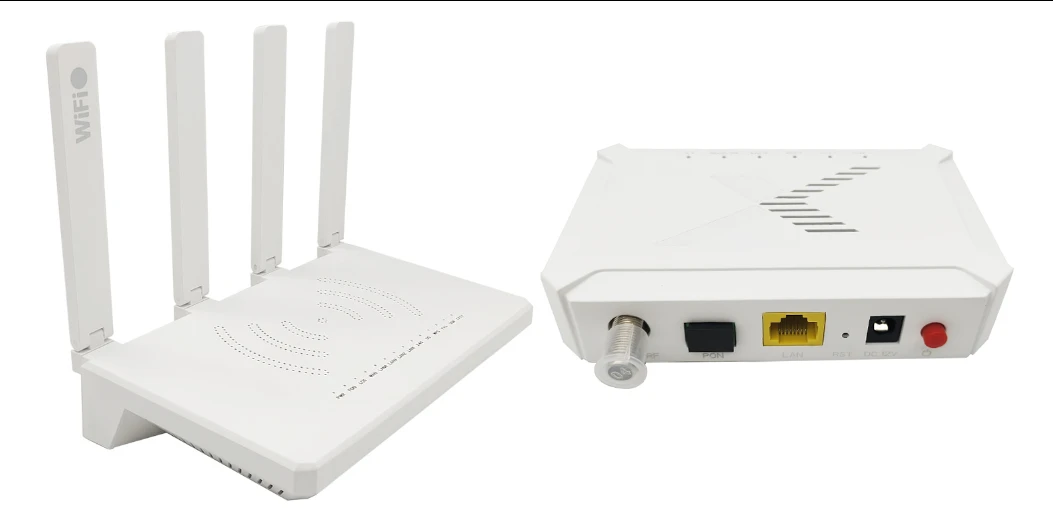
This is the most common application scenario for ONUs, typically referred to as FTTH (Fiber to the Home). Service providers run fiber optic cables into homes, where the ONU is usually installed in the living room, study, or utility box. It connects to household devices such as computers, smart TVs, and routers via wired interfaces (Ethernet ports) or, in the case of wireless-enabled ONUs (often called "optical modems"), provides whole-house Wi-Fi coverage. This meets household demands for high-speed internet, IPTV, voice calls (landline), and other services.
Enterprise and Office Scenarios
For the network needs of small and medium-sized enterprises or office buildings, FTTO (Fiber to the Office) or FTTB (Fiber to the Building) models are adopted:
Small businesses can deploy an ONU directly in the office area, expanding ports through switches to connect multiple office computers, printers, servers, and other devices. This ensures stable gigabit or even 10-gigabit broadband access, meeting requirements for file transfers, video conferences, cloud-based office work, etc.
In large office buildings, fiber is first connected to an ONU in the floor's utility room, and then distributed to individual offices via local area network cabling.
Commercial Business Scenarios
Various shops, stores, hotels, and other commercial venues are also primary application scenarios for ONUs:
Convenience stores, restaurants, clothing stores, and other retail outlets use ONUs for broadband access to support point-of-sale systems, QR code payments, surveillance cameras, and digital display screens.
Hotels deploy ONUs in each room or on each floor to provide guests with high-speed Wi-Fi and IPTV services, while also meeting the hotel's management system and security monitoring network requirements.
Internet cafes and gaming centers require high-bandwidth ONU devices paired with high-performance switches to ensure smooth, high-speed internet access and online gaming for multiple computers simultaneously.
Campus and Public Service Scenarios
In campuses and industrial parks, ONUs provide network access for teaching buildings, dormitories, office buildings, laboratories, etc., supporting educational systems, campus card systems, security monitoring, and research data transmission.
Public service venues such as hospitals and government service halls use ONUs for stable broadband access, ensuring the efficient operation of systems like appointment and payment platforms, electronic medical record transmission, and government office systems.
Some smart communities and smart parks also utilize ONUs as the foundation for IoT gateways, connecting devices such as access control systems, smart streetlights, and environmental monitoring sensors to enable intelligent management.
In short, wherever there is a need for fiber-optic broadband access and a requirement to convert optical signals into usable electrical signals for end-user devices, an ONU is used. It is a key device in the last mile of fiber-optic networks.
I can help you compile a reference table for selecting ONU models based on different scenarios, making it easier to recommend suitable product models according to specific needs. If you require this, feel free to leave a message or send an email. I am always available for consultation.


