

Recently, in the field of home network and building intelligence upgrades, a technology that leverages existing coaxial cables is quietly becoming an industry focus. The latest data released by several chip and equipment manufacturers shows that terminal devices using the G.hn standard over Coax (transmission over coaxial cable) solution have achieved significant shipment growth in the past quarter. Especially in retrofit projects for existing residential networks in North America and Europe, this technology is becoming a mainstream choice recommended by service providers.
New Value from Old Lines
With the proliferation of gigabit and even higher-speed broadband access, bottlenecks in home internal networks are becoming increasingly apparent. Rewiring with fiber optics or high-spec Ethernet cables is often costly and inconvenient. However, many residences, particularly single-family homes and older apartments, already have widely installed coaxial cables for cable TV transmission. These cables have high bandwidth potential and good shielding performance but have long been idle or underutilized.
The international G.hn (unified high-speed home networking) standard, especially its optimized version for coaxial cable, targets this very resource. It can transform these existing cables into high-speed data channels without replacement. The latest generation of chips already supports actual physical layer speeds exceeding 2 Gbps, with latency and stability performance close to that of dedicated Ethernet cables. This is sufficient to support in-home distribution after gigabit broadband entry, seamless transmission of 4K/8K video streams, and high-bandwidth, low-latency applications like VR.
Market Drivers: Cost and Experience
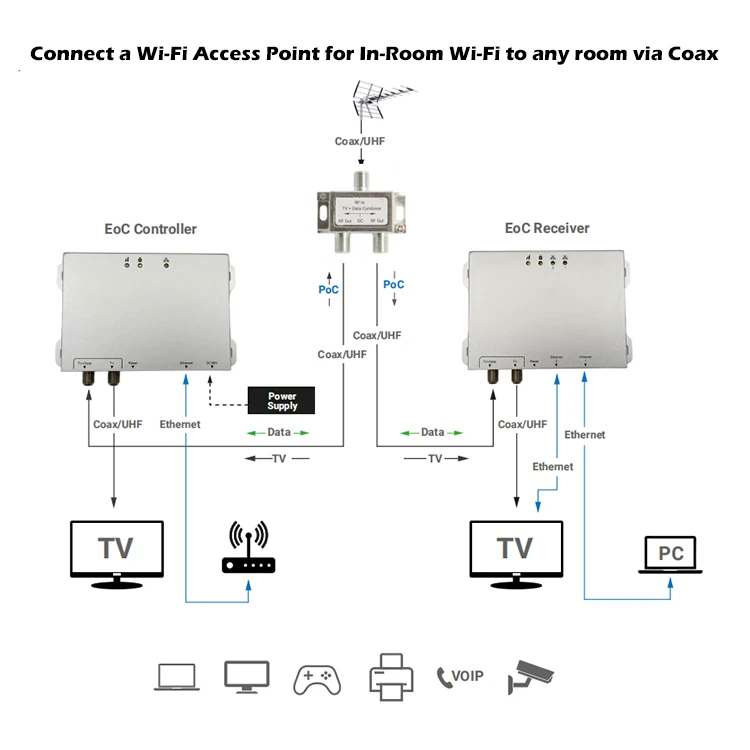
"For both operators and users, this is almost a 'pain-free upgrade' solution," said a product manager from a well-known networking equipment company. Installers typically only need to connect the user's existing coaxial cable outlet to the optical modem or gateway on one end and to a G.hn over Coax-enabled adapter or a router/TV box with built-in functionality on the other end to extend the network signal to various rooms. The process is quick, non-destructive to décor, and significantly lowers the deployment barrier for whole-home gigabit coverage.
Furthermore, compared to MoCA technology, which also utilizes coaxial cables, the G.hn standard has broader alliance support and the potential for unified adaptation across multiple cable media (including phone lines and power lines). Although MoCA still holds its ecosystem advantages in the coaxial-specific market, the openness of G.hn is attracting more device manufacturers, which is expected to lead to more competitive pricing.
Extending Application Scenarios: Beyond Homes
Beyond the home market, this technology is also demonstrating unique advantages in network retrofit projects for hotels, hospitals, campuses, and multi-building commercial complexes. These venues commonly face challenges like complex building structures and difficult wiring, while their abundant existing coaxial resources provide the possibility for low-cost, high-quality network backhaul or private network coverage. Some security equipment manufacturers have also begun integrating G.hn over Coax interfaces to simplify the deployment of high-definition surveillance cameras.
Challenges and the Future
Despite promising prospects, the technology still needs to address challenges such as increasing market awareness, competing with wireless solutions like Wi-Fi Mesh, and optimizing adaptive stability in complex, aging cable environments. Industry insiders point out that as Fiber-to-the-Home (FTTH) advances further, the demand for wired backbone networks within homes will only increase, not decrease. Leveraging its unique "legacy utilization" advantage, G.hn over Coax is carving out a rapidly growing niche in the existing market, paving the "old road" of coaxial cable with the "new asphalt" of high-speed data.
The next focus for the industry chain will be on further reducing power consumption, improving multi-node management efficiency, and promoting the integration of this functionality as a standard feature in terminal devices like smart gateways and internet TV boxes to accelerate widespread adoption.


