

Introduction
As fiber-to-the-home (FTTH) networks become the global standard for high-speed broadband, understanding the critical components that ensure their performance is essential for operators. Among these, the FTTH optical receiver plays a pivotal role in delivering seamless video, voice, and data services to end-users. This blog post delves into the fundamentals of FTTH optical receivers, their technical specifications, and why they matter for network operators.
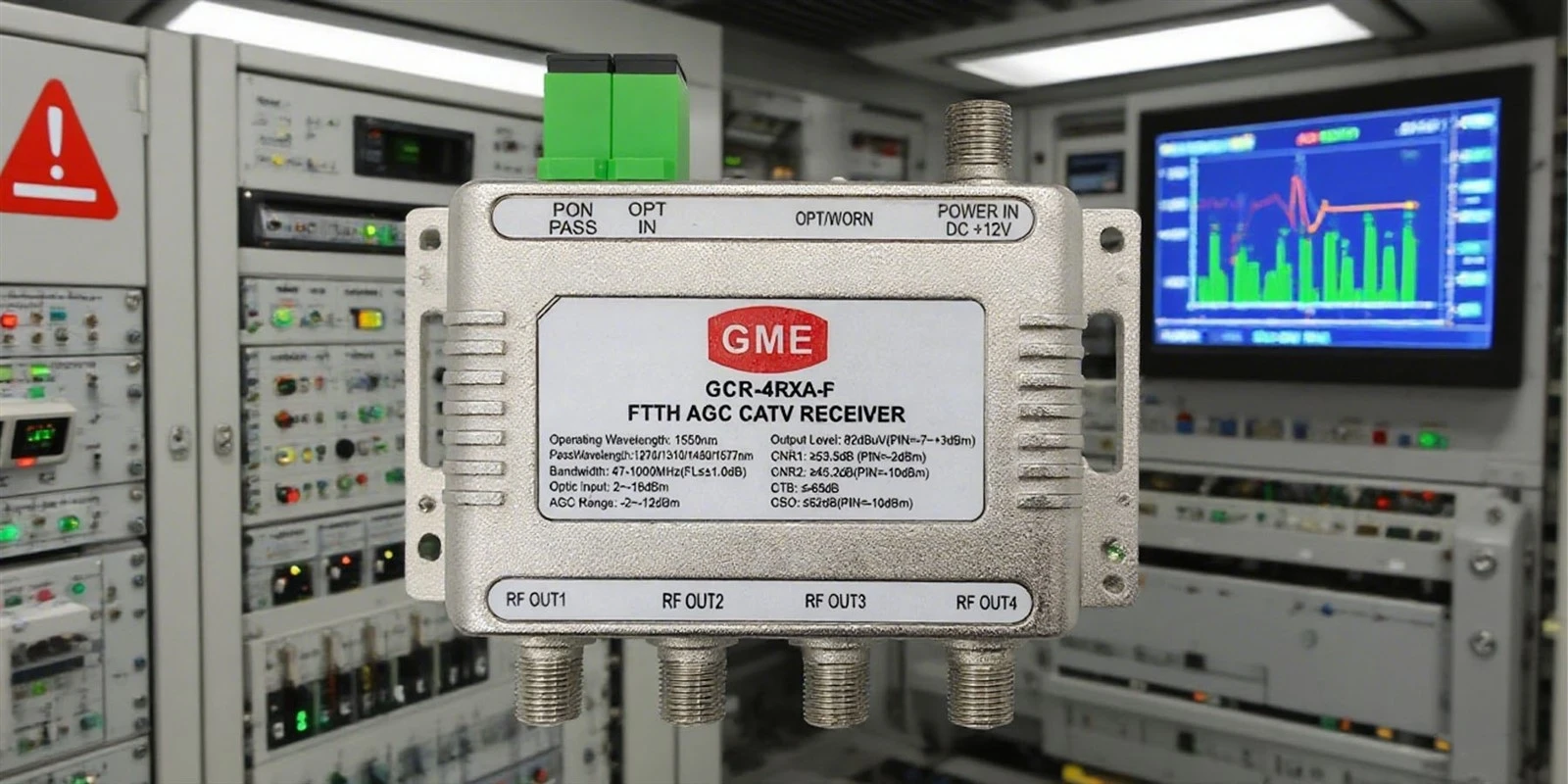
1. What is an FTTH Optical Receiver?
An FTTH optical receiver is a device installed at the user's premises (e.g., homes or offices) to convert optical signals transmitted via fiber cables into electrical signals for distribution through coaxial cables or Ethernet networks. It serves as the bridge between the passive optical network (PON) and customer-facing devices (e.g., set-top boxes, routers, or TVs).
Key Functions:
Photoelectric Conversion: Translates light signals (typically at 1310nm/1550nm wavelengths) into RF electrical signals.
Signal Amplification: Boosts signal strength to ensure optimal output levels (e.g., 72–95 dBμV).
Noise Reduction: Minimizes signal degradation using low-noise amplifiers (GaAs technology is common).
2. Key Components and How They Work
Modern FTTH optical receivers integrate advanced components to enhance reliability and performance:
Photodiode: Usually a PIN photodiode, which converts light to electrical signals with high quantum efficiency (70–90%) and low dark current.
Impedance Matching Network: Ensures efficient signal transfer between the photodiode and amplifier.
Low-Noise Amplifier (LNA): Critical for maintaining signal integrity; often built using GaAs chips for minimal noise.
Microprocessor-Based AGC: Automatically adjusts gain based on input power levels (e.g., -18dBm to 0dBm) to stabilize output.
WDM Filters: Enable triple-play services (video, voice, data) by separating wavelengths (e.g., 1310nm/1490nm/1550nm).
Working Principle:
Optical signals enter the receiver via an SC/APC or FC/APC connector. The photodiode converts them to electrical signals, which are then amplified, filtered, and output through RF ports (e.g., F-type connectors).
3. Technical Specifications Operators Should Know
For operators, selecting the right optical receiver requires attention to these parameters:
| Parameter | Typical Value | Importance |
| Wavelength Range | 1100–1600 nm | Compatibility with PON systems (GPON/EPON). |
| Input Power Range | -18 dBm to 0 dBm | Determines sensitivity and dynamic range. |
| Output Level | 72–95 dBμV | Ensures sufficient signal strength for end-user devices. |
| Noise Figure (NF) | ≤2.5 dB | Critical for maintaining signal quality (CNR ≥52 dB). |
| MER | ≥32 dB | Essential for digital signal integrity (e.g., for IPTV). |
| Power Consumption | <1–3 W | Red operational costs and thermal management. |
4. Why FTTH Optical Receivers Matter for Operators
Cost Efficiency: Modern receivers simplify last-mile connectivity, replacing expensive copper infrastructure.
Future-Proofing: Support high-bandwidth applications (e.g., 4K/8K video, IoT) and data rates up to 10 Gbps.
User Experience: Features like automatic gain control (AGC) ensure stable performance despite fluctuating input power.
Triple-Play Integration: With WDM technology, a single receiver can handle video, voice, and data.
5. Deployment Considerations
Environmental Resilience: Choose receivers with wide operating temperatures (-40°C to 85°C) for outdoor use.
AGC Flexibility: Opt for receivers with programmable AGC ranges (e.g., -12dBm to -2dBm) to adapt to network variances.
Security and Reliability: Prioritize models with surge protection (e.g., IEC 1000-4-5 compliance) to prevent damage from voltage spikes.
6. Future Trends
Miniaturization: Compact designs (e.g., 75mm × 66mm × 28mm) for space-constrained installations.
Energy-Saving Features: Infrared sensors to power down unused receivers.
Enhanced Sensitivity: Research into coherent reception techniques for better performance.
FTTH optical receivers are indispensable for delivering high-quality broadband services. By understanding their technical nuances and evolving capabilities, network operators can optimize investments, enhance user satisfaction, and build robust future-ready networks.


