

G.hn (Gigabit Home Networking) is an advanced wired networking technology under the International Telecommunication Union (ITU-T) designed to achieve high-speed data transmission using existing wiring within buildings. It is not a new cabling system, but rather an "enabling" technology that transforms a home's power lines, phone lines, and coaxial cables into a robust, high-speed network backbone. It is regarded as one of the ultimate wired solutions for solving the challenges of modern home network coverage.
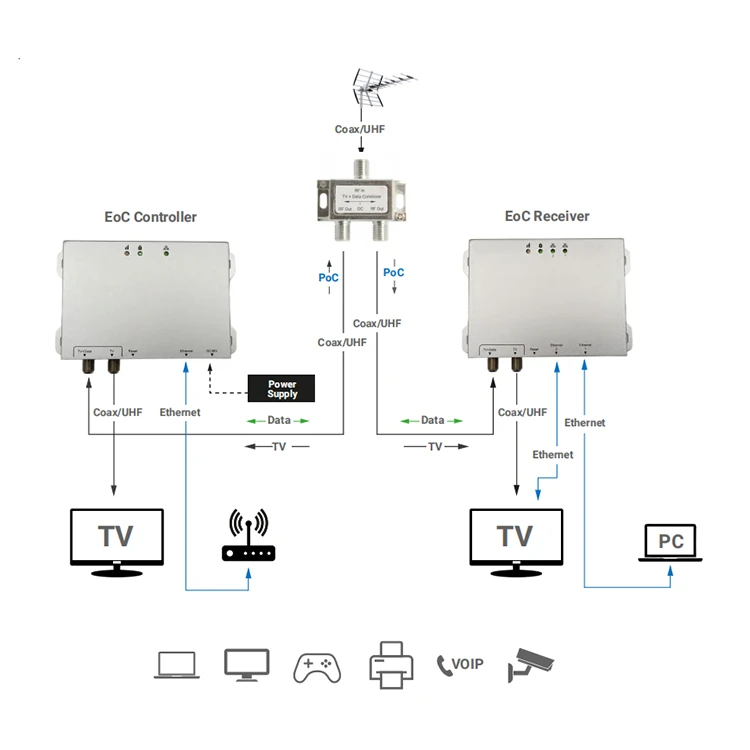
Core Working Principle: Transforming Wires into Network Cables
G.hn technology can turn noisy power lines into high-speed network pathways, primarily due to its three core technological cornerstones: OFDM modulation, advanced error correction mechanisms, and efficient Media Access Control (MAC) .
1. Physical Layer Foundation: OFDM Modulation Technology
Home power lines are not designed for data transmission; they cause signal attenuation, interference, and noise. G.hn tackles this challenge at the physical layer by employing Orthogonal Frequency Division Multiplexing (OFDM) technology.
Multi-carrier Transmission: The core idea of OFDM is to split a high-speed data stream into multiple parallel low-speed data streams, each modulated onto multiple mutually orthogonal subcarriers for transmission. An analogy is breaking down a large truck fully loaded with goods (the high-speed data stream) onto many small carts (the subcarriers) to transport them simultaneously.
Noise and Interference Resistance: The advantage of this method is that even if some subcarriers are unusable due to noise or signal attenuation (e.g., interference from appliances), other subcarriers can continue transmitting data. The system can even actively shut down subcarriers in affected frequency bands (known as "notching") to avoid interfering with radio services like shortwave broadcasting, ensuring the stability of its own connection.
Frequency Band Utilization: G.hn technology typically uses frequency bands ranging from 1.8 MHz to 100 MHz or even wider, achieving physical layer (PHY) rates of up to 1 Gbps or even 2 Gbps by efficiently utilizing spectrum resources.
2. Ensuring Data Reliability: LDPC Error Correction Coding
The power line environment is subject to impulse noise (e.g., from motor startups), which can cause burst errors in data. G.hn employs Forward Error Correction (FEC) technology known as Low-Density Parity-Check (LDPC) codes.
Proactive Error Correction: LDPC is an advanced coding technique that approaches the Shannon limit. The transmitter adds redundant check information to the data. Even if the receiver gets a partially corrupted data packet, it can use this check information and complex mathematical operations to directly recover the original data, without needing to request a retransmission from the sender. This greatly improves transmission efficiency, reduces latency caused by retransmissions, and ensures the smoothness of real-time applications like video streaming.
3. Network Coordination Mechanism: TDMA and CSMA
The Media Access Control (MAC) layer of G.hn uses a hybrid coordination mechanism primarily based on Time Division Multiple Access (TDMA) , supplemented by Carrier Sense Multiple Access with Collision Avoidance (CSMA/CA) .
Guaranteeing Quality of Service (QoS): For latency-sensitive applications like video and voice, the Domain Master (the coordinating role in a G.hn network) uses TDMA to reserve dedicated transmission time slots for these data streams, ensuring they obtain guaranteed bandwidth and low latency, and avoiding collisions.
Accommodating Data Bursts: For regular data traffic, the CSMA/CA method can be used, where nodes listen to the channel before transmitting and only send when it is idle, thus efficiently managing the overall network traffic.
Evolution and Enhancement: From Wave 1 to Wave 2
G.hn technology continues to evolve, with the current mainstream market offering being the more powerful Wave 2 standard.
G.hn Wave 1: The first-generation standard, with a maximum PHY rate of up to 1 Gbps and actual effective throughput of around 500 Mbps under ideal conditions.
G.hn Wave 2: The second-generation standard boosts the PHY rate to 2 Gbps by extending the frequency band and optimizing coding, effectively meeting the demands of applications like 8K video streaming, VR/AR gaming, and high-speed file transfers. Wave 2 also introduces Quick Noise Adaptation (QNA) technology, which detects and adapts to noise up to 5 times faster than previous generations, effectively reducing latency and improving performance stability in complex interference environments.
Key Technological Advantages: MIMO and Cross-Phase Transmission
G.hn (especially the Wave 2 standard) commonly employs Multiple-Input Multiple-Output (MIMO) technology, which is key to its performance surpassing older standards.
Multi-path Transmission: Traditional power line communication (like early HomePlug) typically uses only one pair of wires (Live and Neutral) for Single-Input Single-Output (SISO) transmission. In contrast, G.hn MIMO can utilize the three wires (Live, Neutral, and Earth) of a home's electrical system to create multiple transmission channels. This is like widening a single-lane road into a multi-lane highway, significantly increasing data throughput and stability.
Solving the Cross-Phase Challenge: In residential buildings, different rooms might be on different electrical phases. Older technologies struggle for signals to cross phases, leading to network dropouts. G.hn MIMO technology effectively utilizes multi-path signals to achieve efficient communication between different phases, significantly expanding the reliability and range of network coverage.
Comparison with Other Technologies
Note: Compared to mainstream Wi-Fi technologies, the G.hn power line solution is better suited for solving signal coverage problems after signals pass through walls, providing a more stable connection experience.
Application Scenarios
With its high speed, low latency, high security, and ability to leverage existing wiring, G.hn technology is widely used in several areas:
Home Networks: Eliminating Wi-Fi dead zones, providing stable, high-speed wired connections for devices like smart TVs, game consoles, IPTV set-top boxes, and PCs.
Business Extensions: In offices, hotels, apartments, etc., extending network access to every room without the need for construction, while providing secure network access for guests.
Industrial and IoT: In applications such as smart elevators, electric vehicle charging stations, and smart meters, using power lines for device data backhaul and control, avoiding the high cost of laying communication cables in complex environments.


